Web-to-app is a marketing strategy that takes users through a dedicated web page before redirecting them to the app store, rather than sending them there directly.
This additional step is not a waste of time. It is a genuine conversion lever. It gives advertisers the opportunity to introduce the offer, tailor it to the audience and give users a compelling reason to install the app before they even reach the store.
Web-to-app has grown as app store tracking has become less effective. This guide explains why, how to build a web-to-app funnel and the main mistakes to avoid.
Key takeaways
- Sending traffic directly to the app store is becoming less effective: fewer signals, less context and lower conversion rates.
- Web-to-app adds an intermediate step, a dedicated landing page, between the ad and the installation.
- Conversion rates can be up to three times higher than on a traditional website, with uplifts reaching 94% in retail.
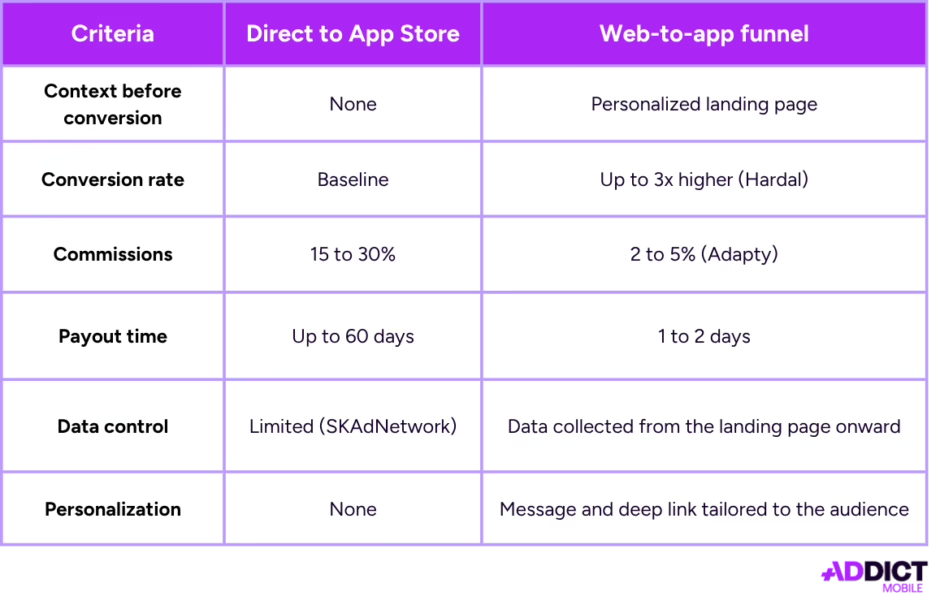
- Payments processed outside the stores are received within one to two days, compared with 60 days for in-app payments processed through the stores.
- Fees charged on the web, typically between 2% and 5%, are significantly lower than app store commissions, which range from 15% to 30%.
- The success of a web-to-app funnel depends as much on the volume of creatives tested as on the fluidity of the transition from web to app.
What is web-to-app?
Web-to-app is an acquisition journey that guides users from an ad or website to an intermediate page before redirecting them to an app. The purpose of this page is not to sell the app itself, but to prepare users for conversion with personalized, interactive content.
The journey may begin with an ad displayed on the open web or inside another mobile app that redirects users to a dedicated landing page. In both cases, the principle is the same: users are not sent directly to the store without first being given a reason to install.
This model is particularly effective for apps that rely heavily on personalization, including health and fitness, astrology, fashion, education, media and gaming.
Why has web-to-app become so important?
Web-to-app has become increasingly important since the introduction of SKAdNetwork, Apple’s framework that limits individual tracking for iOS users and deprives advertisers of many of the signals they previously relied on to optimize their campaigns.
With fewer signals available, advertising platform algorithms lose precision. The result is lower-quality acquired users and a CPI that inevitably increases.
User intent is another issue. When someone installs an app directly from the app store without first seeing content that explains why they should do so, their initial intent is weaker. The jump from the ad to the app store creates a disconnect: there is no page to convince the user or address potential friction, only a leap into the unknown.
Web-to-app fills this gap with links, banners and prompts that guide users step by step, from the moment they see the ad to the moment they open the app.
This is exactly what the visuals below show, taken from a single campaign for Le Monde: several creative variations, each designed for a different target. This approach increases conversions, since each profile receives a message tailored to them, rather than a single generic ad sent to everyone.

How does a web-to-app funnel work?
A web-to-app funnel creates a continuous journey across three elements: the ad, the landing page and the app. A user sees an ad, clicks on it, lands on a page tailored to their profile and campaign, and is then redirected to the app through a deep link. This link takes them directly to the relevant content within the app, without requiring them to search for it again.
This continuity can also be supported by Custom Product Pages. Advertisers can create several landing pages for different audiences, each connected to its own CPP in the store, maintaining message consistency throughout the entire journey.

On the landing page, users may also be asked to complete a short quiz. This provides more information about their profile and makes it possible to personalize the rest of the journey, including the content, recommendations and offer they see.
Building a web-to-app funnel requires several technical components: deep links, conversion APIs, an MMP for attribution and analytics, dedicated landing pages and a Web SDK to connect web data to a consistent cross-platform journey.
One aspect is often overlooked: the visual experience must remain consistent between the web and the app. Colors, tone and structure should all align, as any visual disconnect recreates the very friction that web-to-app is designed to remove.
What are the benefits of web-to-app for advertisers?
Web-to-app delivers tangible benefits at every stage of the acquisition journey. By adding a dedicated landing page before the app store, advertisers can increase conversion rates, gain greater control over user data and reduce platform costs. These advantages accumulate throughout the funnel, from the ad to the installation, which explains why a growing number of apps are adopting this strategy instead of sending users directly to the store.
Higher conversion rates
According to Hardal, apps appear to convert up to three times better than traditional mobile websites, with uplifts reaching 94% in retail.
A richer user experience
A landing page supports features, personalization and a level of fluidity that an app store page cannot provide.
More reliable attribution
Even with tracking restrictions, the data collected on the landing page before installation helps advertisers reconstruct a journey that the app alone can no longer capture.
More controlled acquisition costs
The web can reach audiences that traditional app install channels do not, generally at a lower cost.
Precise deep linking
Users land exactly where their web journey left off inside the app, with no additional steps.
Better ROI
A higher conversion rate than on a traditional website directly translates into a stronger return on investment.
Greater control over user data
Advertisers retain control of the user data collected before installation, which the app store does not allow.
Lower platform costs
When web payments are available, advertisers replace the 15% to 30% commission charged by app stores with generally lower payment-processing fees. The difference comes from the number of intermediaries involved. For an in-app purchase, Apple or Google collects the payment, processes taxes, refunds and currency conversions, and then transfers the revenue to the developer. According to RevenueCat, this payout can take 68 days or more on the App Store. By processing payments directly on the web, brands reduce costs, retain a larger share of their revenue and receive their funds sooner.
Higher engagement and LTV
Users who have been prepared through a consistent journey are more likely to remain engaged over time.
How can advertisers create a seamless transition from web to app?
Creating a seamless transition from web to app means managing the most delicate moment in a web-to-app funnel: the switch between the two environments. Four methods can connect users as soon as they enter the app, each with its own trade-offs in terms of fluidity, reliability and technical complexity.
- Email matching: Data collected during the web onboarding process, such as an email address, is used to recognize users when they arrive in the app and log them in instantly, without displaying a login screen. This method requires dedicated backend infrastructure.
- Auto-login through a deep link: Users arrive in the app already logged in, without going through a login screen. This is the smoothest method, but also the most fragile: if the deep link breaks, the entire journey breaks with it.
- Magic link: Users receive an email link that lets them log in without a password. This option is simple to implement but ineffective if the email address submitted earlier in the journey is invalid.
- Account creation within the funnel: Users create their account before installing the app. Their data is therefore secured from the outset, but this adds a login step to the journey and increases technical complexity.
No single method is universally better than the others. The right choice depends on how much friction the target audience is willing to accept.
Note: A web-to-app funnel is never static. It must be continuously tested and optimized to maintain performance.
How can advertisers avoid friction in a web-to-app funnel?
To avoid friction in a web-to-app funnel, advertisers need to analyze every stage of the journey, from the landing page to the user’s arrival in the app, and identify exactly where users drop off. The message, form, payment process, deep link and login experience must all remain simple, consistent and regularly optimized using funnel data. Several signals can help identify these friction points and determine which optimizations to prioritize:
- High landing page abandonment rate: This is often caused by poorly calibrated messaging, an unclear CTA or excessive loading times. These elements should be tested first.
- Low personalization quiz completion rate: Displayed at the beginning of the journey to help advertisers understand the user, the quiz must remain short, engaging and optimized for mobile. Otherwise, it can become an obstacle instead of a conversion lever.
- Drop-off before payment: Offer several payment methods, display reassurance elements and simplify the checkout process.
- Deep link and login issues: Provide multiple login options and regularly check that deep links are working correctly.
- Ad fatigue: Rotate creatives, analyze funnel data to identify drop-off points and adapt to changes in advertising platform algorithms.
Conclusion
Web-to-app is not a way to circumvent app stores. It is a structural response to the loss of tracking signals and the weaker intent of users sent directly to an app installation. When properly designed, it improves conversion rates, reduces platform costs and gives advertisers greater control over their data.
This strategy is particularly relevant for startups and apps looking to expand their paid reach, improve profitability or reach an older audience that is more comfortable using the web than app stores.
Its success depends on striking the right balance: the landing page must be compelling enough to prepare users for conversion, while the transition to the app must be smooth enough to preserve their intent.
At Addict Mobile, we support advertisers throughout the entire web-to-app funnel, from landing page creation to conversion journey optimization. Contact our teams to find out more.
FAQ
What is the difference between web-to-app and a traditional app install campaign?
A traditional app install campaign sends users directly from the ad to the app store. Web-to-app adds an intermediate step: a dedicated landing page that prepares users for conversion before they reach the store. This step provides context for the offer and can significantly increase the conversion rate.
Is there a minimum budget for testing a web-to-app strategy?
Yes. A test budget of between €15,000 and €30,000 is generally required to properly test a web-to-app funnel across creatives, platforms and audiences. Below this threshold, the data collected is often insufficient to draw reliable conclusions.
How does web-to-app affect platform costs?
Web-to-app can significantly reduce the commissions paid to app stores. Payments processed directly on the web carry fees of between 2% and 5%, compared with 15% to 30% for an in-app purchase processed by Apple or Google. Funds are also received sooner: within one to two days for a web payment, compared with up to 60 days for an in-app payment.
How can advertisers prevent deep links from breaking in a web-to-app funnel?
Deep links should be tested regularly to ensure that they direct users to the correct in-app content. Backup login options, such as a magic link, should also be available if the deep link fails. A broken deep link interrupts the entire conversion journey.
Which sectors benefit most from web-to-app?
Apps that rely heavily on personalization benefit the most, particularly those in health and fitness, astrology, fashion and style, education and, to a lesser extent, gaming. In these sectors, tailoring content to the user’s profile before installation can significantly increase conversion intent.