In just a few months, ChatGPT Ads has gone from something to watch to an actionable advertising channel. It now allows brands to appear at a particularly strategic moment: when a user expresses a need, compares options, or looks for a solution.
Still in beta, ChatGPT Ads has expanded rapidly beyond its initial U.S. pilot and is now available across more than 40 markets, with self-service access through Ads Manager available in a growing number of countries (source: OpenAI). The platform already offers the core features needed to launch, target, and measure campaigns. Testing early can therefore help advertisers build an initial advantage, as long as they don’t go in blind.
At Addict Mobile, our teams have started running ChatGPT Ads campaigns for several advertisers. Here, we share our early learnings and the key operational practices to know.
Key Takeaways
- Select a limited number of intents to concentrate your budget and compare results.
- Test different levels of specificity, from broad messaging to specific situations.
- Align each ad with a destination tailored to the targeted intent and a reliable measurement setup.
- Allocate enough budget to generate meaningful data for each intent tested.
- Monitor spend throughout the day, while accounting for the 24–48-hour delay in attributed conversion reporting within ChatGPT Ads Manager.
How Does ChatGPT Ads Work and What Makes It Different?
ChatGPT Ads selects ads based on the context and intent expressed in the conversation, rather than relying solely on keywords or audience profiles.
Where and When Do Ads Appear in ChatGPT?
ChatGPT Ads works in three main steps:
- The user asks a question or describes a situation in natural language.
- ChatGPT analyzes the context of the conversation and identifies the intent.
- When an offer is considered relevant, an ad may appear directly below the generated response.
The ad is clearly labeled as sponsored and remains separate from the response. Advertisers cannot influence the content of the response or pay to be included within it.
How Is ChatGPT Ads Different from Search and Social Ads?
The main difference lies in the signal used to select the ad. On Google Search, advertisers primarily respond to a query. On ChatGPT, users don’t just express what they’re looking for, but also why, for whom, or under what constraints.
Channel | What Triggers the Ad | What It Changes |
|---|---|---|
Social Ads | User profile, interests, and behavior | The offer is pushed before the need is expressed: creative needs to generate interest |
Search Ads | A short query and keywords | The ad captures existing demand: the landing page needs to confirm that the offer is the right answer |
ChatGPT Ads | A situation described with its context and constraints | The ad responds to expressed intent rather than assumed interest: both the ad and destination need to adapt accordingly |
What Determines Whether a ChatGPT Ad Is Shown?
The platform considers several factors, including:
- the context and intent of the conversation
- the relevance of the offer
- the ad’s headline, copy, and visual
- contextual information provided by the advertiser
- the post-click destination
- targeting criteria
- the bid and expected performance
The bid alone is therefore not enough to guarantee delivery. The offer, ad, and destination need to work together and align with the user’s expressed need.
Which Offers Are a Good Fit for ChatGPT Ads?
An offer is a good fit for ChatGPT Ads if it addresses a clearly expressed need, has an easy-to-understand value proposition, and leads to a measurable action.
Which Verticals Show the Most Potential?
Several types of offers appear particularly well suited to how ChatGPT Ads works:
- Apps and subscriptions, with measurable conversions such as installs, sign-ups, trials, or subscriptions.
- E-commerce and retail, when users are looking for a product that meets a specific need or comparing several options.
- Media, entertainment, and gaming, to recommend content or experiences based on users’ preferences and habits.
- Travel and mobility, where searches often include a destination, budget, or specific constraints.
- SaaS and digital services, which address a clearly identified problem or need.
- Local services, when the need depends on location, availability, or urgency.
These verticals have characteristics that fit the channel, but that alone does not guarantee performance.
When Should You Be More Cautious?
Low-margin products, highly impulsive purchases, and journeys that are difficult to attribute may be less suited to a channel like ChatGPT Ads, where costs are still relatively unstable.
Regulated or sensitive sectors, such as healthcare, finance, or dating, are subject to specific eligibility and delivery rules.
Observed across our clients: OpenAI’s advertising policies are particularly strict, both for these sectors and more broadly. Rejections and longer approval times are common, so it’s best to check offer eligibility before starting production.
How Can You Assess Your Offer’s Potential?
Before launching a test, four questions can help frame the decision:
- What would your user type into ChatGPT just before downloading your app or buying your product? If you can’t write that sentence, the intent probably isn’t clear enough yet.
- What makes your offer better than the answer ChatGPT just provided? The ad appears below an already useful response, so it needs to add something more.
- Does your landing page clearly reflect the promise made in the ad? A generic homepage or app store page may not always be enough.
- Does the conversion you’re measuring reflect real business value? An install without activation or an unqualified lead isn’t enough to assess channel performance.
Not sure yet whether your offer is a good fit for ChatGPT Ads? Addict Mobile’s teams can audit your offer, user journeys and measurement setup to identify which intents to test and what needs to be in place before you launch.
How Should You Structure Your First ChatGPT Ads Test?
A first ChatGPT Ads test should focus on a limited number of intents. The goal isn’t to cover every possible use case from day one, but to compare distinct enough situations to understand which ones generate the most valuable signals.
Which Campaign Objective Should You Choose?
ChatGPT Ads offers three objectives:
- Views, billed on a CPM basis, to maximize exposure
- Clicks, billed on a CPC basis, to drive traffic
- Conversions, billed per click with oCPC or per impression with oCPM, to optimize delivery toward a configured event
The right choice depends on your business objective and the quality of the available signal. To optimize for conversions, the selected event needs to be accurately measured and represent a genuinely valuable action.
How Does Targeting Work on ChatGPT Ads?
Campaigns can be targeted by:
- Geography: in Europe, targeting is limited to the country level, with no option to target a specific region or city. Regional offers should therefore specify their location in both the messaging and context hints.
- Platform: five environments can be targeted at campaign level: iOS app, Android app, iOS web, Android web, and desktop web.
The channel’s main targeting specificity, however, lies in context hints. Set at the ad group level, these signals help the platform understand:
- what the advertiser offers
- what need the offer addresses
- in which situations it may be useful
Context hints are not keywords and cannot force an ad to appear for a specific query. They provide the system with additional context to help assess the relevance of the offer.
How Should You Structure Campaigns Around Intent?
The structure has three levels:

The campaign contains the objective, budget, and delivery settings. Each ad group corresponds to a product, service, or family of needs, with its associated context hints. Ads then adapt the messaging to those needs.
For a language-learning app, for example, three ad groups could address different needs:
Intent | Messaging Angle |
|---|---|
Preparing for a trip | Learn essential vocabulary quickly |
Advancing professionally | Practice for workplace situations |
Building a routine | Improve in just a few minutes a day |
How Specific Should Your Ads Be?
Within the same intent category, our teams recommend testing different levels of specificity.
For the intent “advancing professionally,” a language-learning app could compare:
- A broad message: “Learn English”
- A mid-level message: “Improve your business English”
- A specific message: “Communicate more easily in English during international meetings”
Observed across our clients: in our early tests, highly specific messaging could make the ad more relevant, but also limit delivery. Testing different levels of specificity therefore helps identify the right balance between volume and performance, rather than committing to a single approach upfront.
How Should You Align a ChatGPT Ad with Its Destination?
Journey consistency is essential to turn the interest generated by the ad into a conversion:

After the click, users should find the same promise that led them to engage with the ad. The more specific the need, the less suitable a generic homepage or app store page will be.
Why Adapt the Destination to Each Intent?
Observed across our clients: in an initial test for PlayVOD, Digital Virgo’s entertainment service for movies, series, and gaming, several intents were tested within the same campaign.
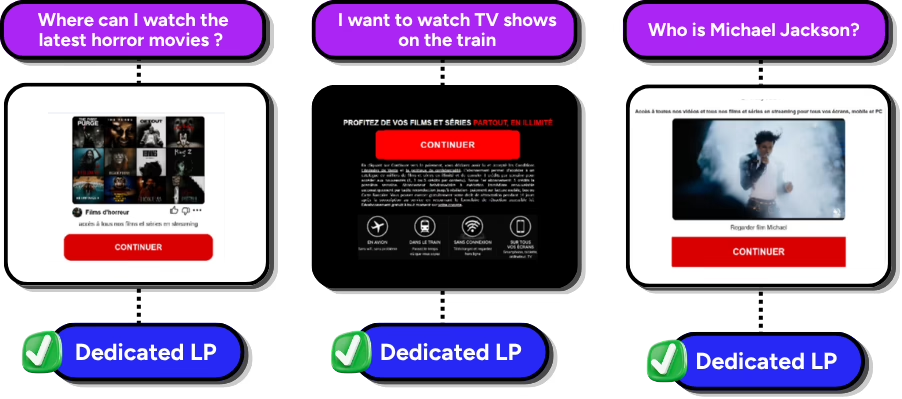
| Expressed Intent | Destination |
|---|---|
Find the latest horror movies | A page dedicated to the horror movie catalog |
Watch series on the train | A page highlighting mobile viewing and offline access |
Learn more about Michael Jackson | A page dedicated to a film about the artist |
The goal isn’t just to personalize the ad, but to carry its message through after the click. A single campaign may therefore require multiple ads and destinations to address different intents.
How Should You Adapt the Destination for Web and App Journeys?
For a Web campaign, the ad can lead to a dedicated landing page, product page, category page, comparison page, or form. The right destination depends on the targeted intent and the action expected after the click.
For an App campaign, there are two possible journeys:
- redirect users directly to the app store: the shortest route, but the store page remains the same regardless of intent
- use an intermediate landing page that extends the ad’s message before directing users to the app. This approach also makes it easier to manage desktop and mobile journeys.
Testing multiple intents therefore means planning ahead for the ads, creatives, and, when journeys differ, the destinations required.
What Should You Check Before Launching the Campaign?
Whatever the journey, test the final URL, redirects, and tracking parameter persistence. On the Web side, this means checking the Pixel, CAPI, and configured events, and using dedicated UTM parameters for each creative.
On the App side, ChatGPT Ads is compatible with the main MMPs (source: OpenAI). The integration needs to be enabled in the MMP, the attribution link generated there should be used in the campaign, and both device-specific redirects and post-install event reporting should be tested.
An error in this setup can distort performance analysis before the campaign has even generated enough data.
Observed across our clients: plan ahead for account verification and billing setup. A campaign may start delivering and then be interrupted if some mandatory steps haven’t been completed.
How Should You Measure and Optimize a ChatGPT Ads Campaign?
Our early tests highlight two key points to watch: budget can be spent faster than expected, and conversions can take 24 to 48 hours to appear. Campaigns therefore need to be monitored regularly, without reacting too quickly to the latest data.
What Budget Should You Set for a First ChatGPT Ads Test?
The budget should be based on the expected CPC, the number of intents being tested, and the volume needed to compare their results.
The more ad groups and variations a campaign includes, the more the budget is spread across different hypotheses. Testing too many intents with a limited budget may therefore generate too little data for each one.
The right budget isn’t simply what the advertiser is willing to spend, but what gives each hypothesis enough opportunity to be properly tested.
Why Monitor Budget Spend Throughout the Day?
Observed across our clients: even with a daily budget in place, it can be fully spent before the end of the day. The campaign then stops delivering during certain time slots, including those that may generate more conversions.
It’s therefore important to analyze not only how much the campaign spends, but when it spends it. Depending on the results, several adjustments can be made:
- adjust budgets or bids to maintain delivery during the best-converting time slots
- limit the number of intents running simultaneously
- prioritize the most promising ad groups
Why Wait Before Optimizing for Conversions?
Observed across our clients: attributed conversions can take 24 to 48 hours to appear in the platform. Results from the previous day, or even two days earlier, may therefore still be incomplete. Changes should be documented and left active long enough to measure their impact.
The right approach: monitor delivery daily, but don’t optimize performance daily.
Finally, as ChatGPT Ads is still in beta, it’s important to date each test and keep a record of its configuration. Features and delivery options are evolving quickly, and so are the learnings advertisers can draw from them.
Conclusion: Test Early to Build an Advantage
A first ChatGPT Ads test shouldn’t simply determine whether the channel can drive traffic. It should help identify which intents find their audience, which messages resonate most, which App or Web journeys convert, and whether the observed costs are consistent with the value generated.
Testing during the beta helps establish these initial benchmarks before the channel matures and competition increases. The advantage comes less from being there early than from learning quickly and adapting your strategy accordingly.
As the platform continues to evolve, this article will be updated with new features and insights from campaigns run by Addict Mobile. We’ll also share our latest learnings on our LinkedIn page.
ChatGPT Ads FAQ
What is ChatGPT Ads?
ChatGPT Ads is OpenAI’s advertising platform. It allows advertisers to display sponsored content below certain ChatGPT responses when their offer matches the context and intent expressed in the conversation.
Who Sees Ads in ChatGPT?
Ads are shown to users on the Free and Go plans. Plus and Pro subscribers, Business, Enterprise, and Education accounts, as well as users identified as minors, do not see ads.
Where Do Ads Appear in ChatGPT?
An ad may appear below the generated response when an offer is considered relevant. It is clearly labeled as sponsored and remains separate from the response: advertisers cannot influence the content generated by ChatGPT.
How Does Targeting Work on ChatGPT Ads?
Targeting combines geography, limited to country level in Europe, five delivery environments (iOS app, Android app, iOS web, Android web, and desktop web), and the context hints set within ad groups. Unlike Search keywords, these signals describe the offer, the need it addresses, and the situations in which it may be useful.
What Budget Should You Set for a First ChatGPT Ads Test?
There is no universal budget. The right amount depends on the expected CPC, the number of intents and variations being tested, the campaign duration, and the volume needed to compare results without spreading the budget too thin.
Can ChatGPT Ads Be Used to Promote an App?
Yes. A campaign can send users directly to an app store or through an intermediate landing page. AppsFlyer, Adjust, and Branch are integrated with ChatGPT Ads: an attribution link generated by the MMP can be used to measure installs and post-install events driven by the campaign.