
Incrementality aims to answer a fundamental question: do marketing investments actually generate additional conversions, or do they partly capture users who would have converted anyway?
Because a conversion attributed to a campaign is not necessarily a conversion caused by that campaign. Attributed does not mean incremental.
In theory, incrementality provides exactly what advertisers are looking for: a way to measure the true contribution of their marketing investments. In practice, however, setting up an incrementality testing approach that is reliable enough to inform decisions is far more complex.
Ce qui explique cet écart : sacrifier de la performance visible pour créer un groupe de contrôle, disposer de volumes de conversions suffisants pour un résultat fiable, et faire tenir une méthodologie rigoureuse dans le rythme quotidien du pilotage marketing.
So, if incrementality is so valuable, why is it still so difficult to put into practice?
Key Takeaways
- Attributed doesn’t mean incremental: a conversion attributed to a campaign would sometimes have happened even without that investment.
- Incrementality testing requires certain conditions: sufficient volumes, a relevant control group, and a sufficiently controlled environment.
- Incrementality doesn’t replace attribution: rather, it allows you to challenge and validate certain signals used to steer campaigns.
- Not every investment needs to be tested: incrementality is most relevant when uncertainty is high, the business stakes are significant, and the result is genuinely actionable.
Why is incrementality becoming so important?
Incrementality is gaining importance as marketing measurement becomes increasingly fragmented and attribution alone is not always enough to isolate what a campaign actually generated.
Privacy restrictions are limiting access to user-level data, cross-device journeys are becoming more common, and users are interacting with more touchpoints before converting.
In this context, a conversion attributed to a campaign was not necessarily caused by it. Advertisers are therefore looking for better ways to distinguish between attributed performance and the actual impact generated by their campaigns.
This is also reflected in marketing teams’ priorities: according to a 2025 EMARKETER/TransUnion study, 67% of marketers surveyed cite incremental ROI as one of their measurement priorities.
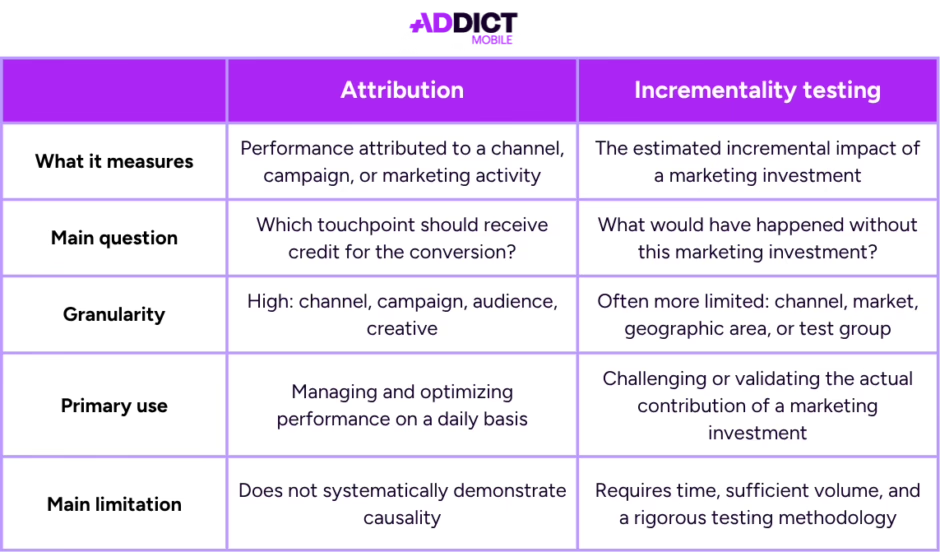
Attribution vs. incrementality: what is the difference when measuring performance?
Let’s take a simple example: a platform attributes 10,000 conversions to a campaign. How many of those conversions would still have happened without exposure to the ad? Attribution alone cannot answer that question.
The gap between attributed and incremental conversions can be particularly significant in several situations:
- Retargeting: targeted users have already shown interest, and some may have returned and converted naturally.
- Brand campaigns: some users are already familiar with the brand and have an intent to convert before being exposed to the ad.
- Paid and organic: a paid campaign may receive credit for a conversion that would otherwise have occurred through an organic channel.
- Multi-touch journeys: several channels may contribute to the same conversion, while attribution still has to determine how credit is distributed between them.
Incrementality testing therefore provides a complementary view focused on the actual contribution of marketing investment. It does not solve the limitations of attribution, nor is it intended to replace it.
What makes incrementality testing so complex in practice?
The principle behind incrementality testing is simple: compare a group exposed to a campaign with a comparable group that is not exposed. In practice, obtaining reliable results requires sufficient volume, a rigorous testing methodology, and a controlled environment. It may also mean accepting a temporary drop in visible performance.
1. Testing means not maximizing performance
Creating a control group means deliberately withholding campaign exposure from part of the audience. This can feel counterintuitive when the day-to-day objective is to maximize the performance of every euro spent.
2. Not every advertiser has enough volume
Incrementality testing needs enough data to distinguish a genuine effect from natural fluctuations in performance. Low conversion volumes, a niche market, or a limited budget can therefore make the results difficult to interpret or act on.
The smaller the incremental effect you are trying to measure, the more volume you need to detect it reliably.
3. Incrementality testing rarely take place in a perfectly stable environment
Many factors can influence conversions while a test is running: seasonality and promotions, budget changes across other channels, offline campaigns, competitor activity, and more.
This is why test design is just as important as the test itself. A difference observed between two groups can only be interpreted correctly if the other factors that could explain that difference are sufficiently controlled.
4. Platform lift studies only provide part of the answer
Meta, Google, and other platforms offer their own lift measurement solutions. They provide valuable insights, but rely on the data and methodologies specific to each platform’s environment.
A lift study should therefore be considered one signal among others and, when necessary, cross-checked with other measurement methods.
5. Granularity quickly runs into statistical limitations
Performance teams manage campaigns at the channel, campaign, audience, or creative level. Incrementality testing cannot always provide the same level of granularity: a test may show that a channel generates incremental value in a given market without being able to accurately measure the incremental impact of every individual campaign.
Attribution provides greater granularity without systematically demonstrating causality; incrementality provides a more robust causal view, but rarely with the same level of detail.
Can incrementality replace attribution in day-to-day campaign management?
Incrementality does not replace attribution when it comes to managing campaigns on a daily basis. Incrementality testing answer broader questions than those that arise in day-to-day campaign management, and they cannot be rerun every time an adjustment is made.
Attribution therefore retains its operational role, while incrementality is better suited to challenging and validating some of the signals used to inform decisions.
A performance team continuously needs to:
- optimize campaigns
- reallocate budgets
- test new creatives
- adjust audiences or bids
Incrementality testing before each of these decisions would be impossible. Incrementality and attribution simply address different needs and operate at different cadences.
The goal is therefore not to replace attribution with incrementality, but to understand when a decision is important enough to be challenged through causal measurement.
When is an incrementality test actually worth running?
An incrementality test is particularly relevant when there is uncertainty about the true contribution of an investment and resolving that uncertainty could change a business decision. The goal is not to measure the incrementality of every campaign, but to focus testing on questions where better measurement can genuinely influence investment decisions.
In practice, an incrementality test can help answer questions such as:
- Does retargeting actually generate additional customers, or does it mainly target users who would have returned anyway?
- Does a new channel generate additional demand, or does it capture demand that already existed elsewhere?
- Does a significant budget increase actually generate more conversions, or mainly lead to higher spend?
- Is paid acquisition cannibalizing some organic conversions?
How do you know if an incrementality test is worth running?
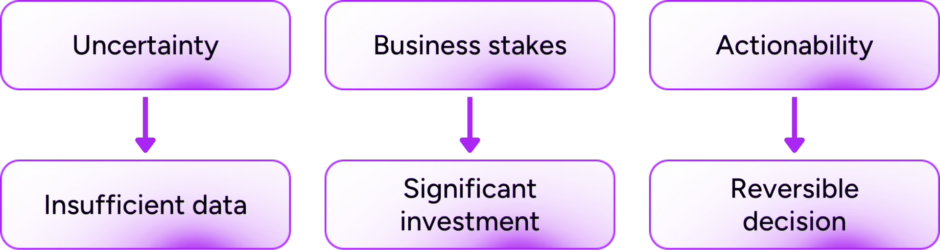
Three criteria can help guide the decision:
- Uncertainty → The available data is not sufficient to answer the question.
- Business impact → The investment at stake is significant enough to justify running a test.
- Actionability → The result could actually lead to a change in decision-making or budget allocation.
An incrementality test can then take different forms, such as Conversion Lift, a control group, a geo experiment, or a temporary reduction in investment, depending on the question being asked and the data available. The different methods are covered in more detail in our incrementality glossary.
Finally, the result should be treated for what it is: an estimate with a degree of uncertainty, not a new perfectly accurate KPI. The goal is to obtain a signal robust enough to make a better decision.
Conclusion: The principle is simple, putting it into practice is not
Incrementality gets so much attention because it addresses a fundamental question in performance marketing: what would actually have happened if I had not invested this money?
Incrementality testing remains less widely implemented because obtaining a reliable answer requires sufficient volume, methodological rigor, and sometimes difficult trade-offs.
The goal is therefore not to run incrementality tests at every opportunity, but to understand which decisions warrant causal measurement and how to use the results to make better investment decisions.
FAQ
What is an incrementality test?
An incrementality test aims to measure the conversions actually generated by a marketing investment. It typically compares a group exposed to a campaign with a comparable unexposed group to estimate what would have happened without that investment. The goal is to distinguish attributed conversions from truly incremental conversions.
What is the difference between attribution and incrementality?
Attribution determines which channel, campaign, or touchpoint receives credit for a conversion. Incrementality seeks to determine whether that conversion would have happened without the marketing investment. The two approaches are complementary: attribution supports day-to-day campaign management, while incrementality testing helps challenge and validate the actual contribution of an investment.
When should you run an incrementality test?
An incrementality test is particularly relevant when there is significant uncertainty about the true contribution of an investment and the results could change a business decision. For example, it can be used to assess the actual impact of retargeting, a new channel, a budget increase, or potential cannibalization between paid and organic.
How many conversions do you need to run an incrementality test?
There is no universal conversion threshold that applies to every incrementality test. The volume required depends on factors such as the size of the effect you are trying to detect, the duration of the test, the budget, and the methodology used. The smaller the expected incremental effect, the more data is generally needed to obtain statistically meaningful results.