CPI (Cost Per Install) is a crucial metric in mobile user acquisition. It measures the average amount an advertiser pays to get a user to install their app via a specific ad campaign. It’s one of the most widely used KPIs in UA (User Acquisition) because it allows for a quick assessment of campaign profitability and helps fine-tune advertising strategies.
But how do you calculate CPI? What factors impact it? And how can you optimize it without sacrificing user quality? This article breaks down everything you need to know about CPI and its role in mobile marketing.
Definition and Calculation of Cost Per Install (CPI)
CPI (Cost Per Install) is a pricing model used in mobile advertising. It represents the amount an advertiser pays to a publisher or ad network each time a user installs the app after interacting with a specific ad.
CPI Formula
Cost per install is calculated by dividing the total budget spent on an advertising campaign by the total number of installs generated by that campaign.

Example:
- Total ad spend: €5 000
- Number of installs generated: €2 500
- CPI = 5 000 / 2 500 = €2
A CPI that’s too high can impact acquisition profitability and require adjustments to marketing strategies. Conversely, a CPI that’s too low can sometimes reflect lower-quality user acquisition (low engagement, poor retention rate, etc.)
What factors influence CPI ?
Cost per install is never a fixed figure. It varies depending on several factors: market, platform, app type, and even time of year. Understanding these elements helps anticipate fluctuations and optimize campaigns accordingly.
Country and Region
CPI is heavily dependent on the target market. In countries with high competition and strong purchasing power (United States, Western Europe), bidding is more intense, driving up acquisition costs. Conversely, in regions like Latin America or Southeast Asia, CPI is often lower due to less advertising saturation and lower purchasing power.
Exemple de benchmarks CPI par région
Example of CPI benchmarks by region
- Latin America: $0.50 – $2.00
- North America: $2.50 – $5.00
Source: Business of Apps
OS (iOS vs Android)
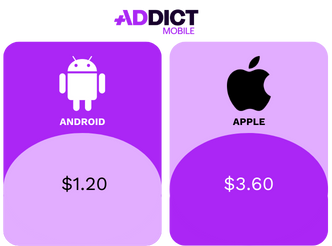
CPI also varies depending on OS. iOS is generally more expensive than Android, as its users are considered more profitable and more advertisers compete to reach them. That said, cost differences vary depending on markets and user segments.
Source: Appsflyer
App Vertical
Each app category has different acquisition costs. A hypercasual game will have a lower cost per install thanks to its large user volume and mass acquisition. Conversely, a fintech or dating app targets a more specific audience that’s often harder to convert, driving up acquisition costs.
Acquisition Source
The choice of advertising platform has a direct impact on CPI, though not always uniformly. Some heavily used networks like Meta and Google Ads often show higher CPIs due to strong competition. Other platforms may offer lower acquisition costs, but this depends on audience type and targeting precision.
Examples of average cost per install by advertising source
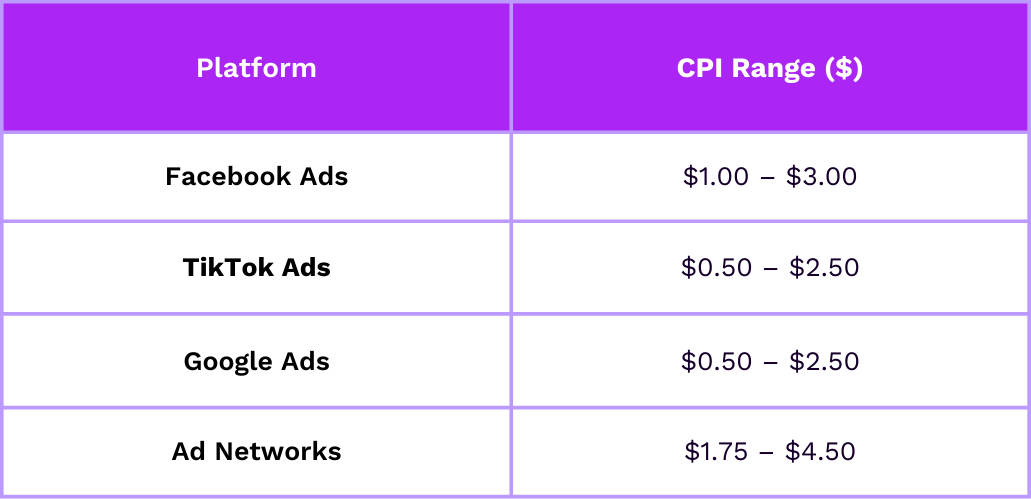
Source: Business of apps
Seasonality
CPI isn’t stable throughout the year. During periods like Black Friday, Christmas, or sales seasons, competition surges and bidding rises. Conversely, quieter periods like summer often see lower CPIs, as fewer advertisers are active.
CPI vs. Other KPIs in User Acquisition
CPI alone isn’t enough to measure the profitability of an acquisition strategy. It needs to be analyzed alongside other KPIs for a complete view of campaign performance.
CPI vs. CPA (Cost Per Action)
CPA measures the cost of a post-install action, such as a sign-up, cart addition, or purchase. Unlike CPI, which stops at the install, CPA shows whether acquired users are actually active and engaged within the app.
Why does this matter?
- A low CPI can be misleading if users don’t take any post-install actions.
- A high CPI may be justified if users show a strong propensity to convert.
Example:
- An e-commerce app has a CPI of €3 and a CPA (first purchase) of €15.
- It optimizes its campaigns and reduces its CPI to €1.5, but its CPA rises to €30.
- Result: the cost of acquiring a buyer doubles, making the campaign less profitable.
Discover how to combine low CPI and engaged users : read the Sofascore use case.
CPI vs ROAS (Return on Ad Spend)
ROAS measures the revenue generated relative to ad spend. A low cost per install doesn’t guarantee a good ROAS if users don’t make purchases or generate little value after installing.
Why does this matter?
- A low CPI isn’t enough if users don’t make purchases after installing.
- A higher CPI can be profitable if users spend more within the app.
Example :
- A gaming app invests €10,000 for 5,000 installs (CPI of €2).
- 10% of users make an in-app purchase, generating €15,000 in revenue.
- ROAS = 1.5 (i.e., ROI of +50%) → The campaign is profitable despite a higher CPI.
CPI vs LTV (Lifetime Value)
LTV measures the total value a user generates over their entire lifetime within the app. Comparing CPI to LTV helps determine whether an acquisition is truly profitable over the long term.
Why does this matter?
- If CPI exceeds LTV, the campaign is running at a loss.
- If CPI stays below LTV, it’s profitable and can be scaled up.
Example:
- A streaming app acquires users at a €4 CPI.
- These users generate an average LTV of €12 over six months.
- Result: the margin is enough to justify the ad investment.
How to reduce CPI while maintaining user quality?
Reducing cost per install without compromising user quality is a key challenge in user acquisition. The goal? Getting profitable installs, not just cheaper ones.
Here are a few approaches:
1. Work on and test ad creatives
Ad creatives have a direct impact on cost per install. A well-designed ad captures attention, improves conversion rate, and reduces cost per install.
- Test multiple formats: short videos, UGC (User Generated Content), carousels, etc.
- Optimize CTAs to maximize clicks.
- Run multiple A/B tests to identify the best-performing visuals.
Pour en savoir plus, découvrez notre article sur le Creative Testing
2. Optimize ad targeting
Targeting too broad generates unnecessary volume, while targeting too narrow drives up cost per install. The challenge is to balance quality and volume.
- Leverage lookalike audiences to reach profiles similar to top-performing users.
- Exclude underperforming segments to avoid wasting budget.
- Adjust based on available data (device, geographic area, usage habits).
3. Optimize ASO (App Store Optimization)
Good ASO boosts store conversion and mechanically reduces cost per install.
Discover how we helped a mobile game improve its store ranking and conversion rates. Read the article.
4. Diversify acquisition sources
Not relying on a single channel helps spread risk and optimize costs.
- Test multiple platforms: Meta Ads, Google Ads, TikTok, DSPs…
- Explore new formats: stories, rewarded videos, in-app ads…
- Analyze and adjust continuously: today’s best channel may not be tomorrow’s
Conclusion
Cost per install is a key metric in mobile acquisition, but on its own it’s not enough to judge a campaign’s profitability. To be effective, it needs to be optimized without compromising the quality of acquired users. High-performing visuals, precise targeting, optimized ASO, and channel diversification are the essential levers for maintaining a good balance between cost and value. The goal isn’t just to lower CPI, but to ensure that every euro invested brings in users who are genuinely engaged and profitable.