In our first article, we explained why a soft launch is essential when launching a mobile game: how to identify the right objectives and KPIs to track, define your budget and timeline, and optimize your store page to maximize conversions. This second article focuses on choosing the right countries for your soft launch based on your objectives and the insights you want to gather. In the third part, we’ll cover how to analyze KPIs during the soft launch and what decisions to make based on the results.
With experience across more than 35 soft launches, including Supercell’s Everdale, Bandai Namco’s Tekken, Gnejoy’s Tuscany Villa, Jam City’s Cookie Jam, and Sandsoft’s Rambo Strike Force, Addict Mobile shares its recommendations for running a controlled and successful soft launch.
Avoid “Burning” Your Audience
Choosing the country where you run your soft launch is a key decision. As a general rule, you should avoid testing in the markets where you plan to officially launch your game. At this stage, the game is still far from perfect, so you don’t want to expose it too early to your most qualified audiences.
If you acquire large numbers of high-quality users for a game they don’t enjoy, don’t keep playing, or that doesn’t monetize well enough, those players won’t be profitable and are unlikely to come back. It’s therefore better to expose these audiences to the game once it has reached a more advanced stage across the board.
This means avoiding your strongest geographies, typically those with the highest monetization potential, and keeping them untouched for the hard launch. These markets also tend to combine strong monetization with large audiences. The US is the most obvious example, followed to a lesser extent by the UK, France, and Germany.
There are, however, exceptions where high-ARPU markets can be useful for testing the viability of a game’s monetization and business model. Hyper-casual games are a good example, as their performance depends heavily on CPI and retention in Tier 1 geographies, particularly the US. In this case, soft launches can be run directly in the US for a very short period to gather insights into the game’s quality and make quick decisions.
Your Objectives Will Determine Which Countries to Target During the Soft Launch
The countries you target will depend on your objectives.
- UX & bug fixing: countries where users are inexpensive to acquire (low CPI).
- Retention: countries where user behavior is similar to that of your target audience. Typically Tier 1 markets.
- Acquisition: choose a country close to your target market to assess CPI / ROAS. If the goal is instead to test targeting, creatives, etc., user behavior will be similar across most countries (but pay attention to language, as explained below).
- Monetization: countries with purchasing behavior (IAP) or eCPMs (IAA) similar to your target audience. Focus on high-ARPU countries with smaller populations.
Another important factor to consider is the language of the game. If the game is only available in one language, usually English, there are two different scenarios to consider.
- If the game has little text or simple gameplay: language will have limited impact, so the game can be launched in almost any geography.
- If the game includes a lot of text or more complex mechanics: language will have a much greater impact. In this case, choose a suitable market, either an English-speaking country or one with a large English-speaking population.
Finally, if you’re considering running your soft launch on a single operating system, keep in mind that KPIs can vary slightly between OSs. iOS penetration is also limited in certain markets.
What About the OS?
The operating system is another important consideration. Should you run your soft launch on both OSs or just one, and if so, which one?
As shown in the analysis below, app developers tend to run tests on Android or on both OSs, but rarely on iOS alone.

One reason is the greater flexibility Android offers when it comes to production, allowing developers to roll out game updates faster and react more quickly to insights gathered during the soft launch. That said, most game developers work on both OSs in parallel.
It’s also worth noting that KPIs can vary significantly between operating systems, with acquisition costs, retention, and monetization generally lower on Android. Conversely, iOS users are often highly engaged and can represent a significant source of long-term revenue.
Looking again at the specific case of hyper-casual games, soft launches generally focus on iOS, as it provides a useful benchmark for CPI, retention, and monetization.
From a User Acquisition perspective, you’ll also need to consider the iOS limitations introduced by ATT (App Tracking Transparency). The data available on Android is much more granular and detailed, allowing you to gather significantly more insights. This is another reason why Android tends to play a larger role during soft launches.
What Are the Major Players Doing?
Addict Mobile analyzed the countries chosen by some of the most anticipated games for their soft launches, first on March 16, 2021, and then on October 9, 2023.
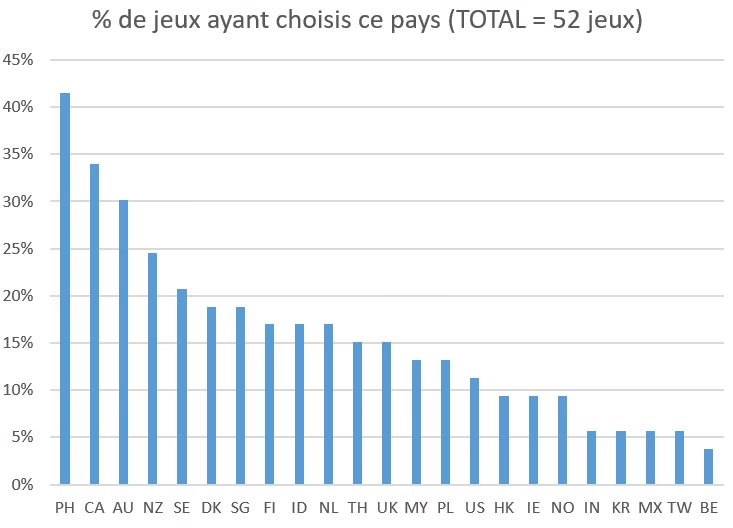
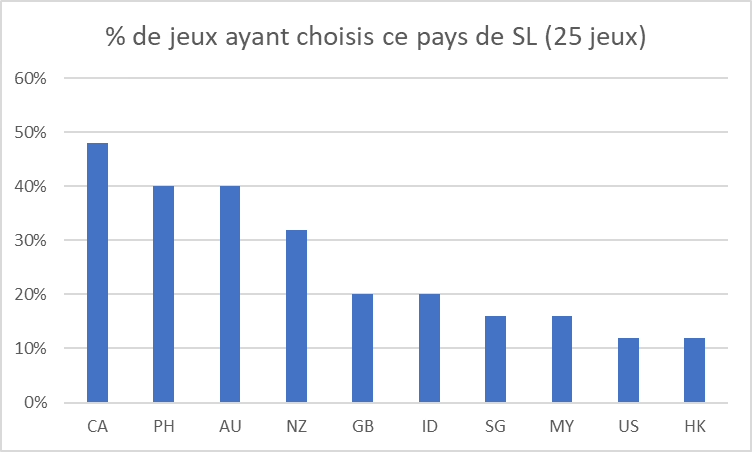
The top four countries chosen for soft launches remained the same over this two-and-a-half-year period.
Which Countries Should You Choose for Your Soft Launch?
With experience across more than 35 soft launches in recent years, Addict Mobile shares its recommendations to help you choose the right country for your next soft launch.
Focus: UX & Bugs
- Philippines: ideal for testing UX and identifying bugs, thanks to very low CPIs and high volume. However, this market should be avoided for monetization or retention testing.
- Myanmar, Thailand, Indonesia: similar to the Philippines, but slightly more expensive, so the Philippines should generally be prioritized.
Focus: UA, Retention & Monetization
- Canada / Australia: traditionally among the most popular soft-launch markets for simulating US user behavior, as both are English-speaking and have higher ARPU (Average Revenue Per User).
Addict Mobile recommends looking for alternatives to these two markets, as they are highly competitive and therefore expensive, since many game developers launch there. Ideally, keep them untouched for the hard launch. Other countries can offer interesting opportunities:
- New Zealand: follows the same logic as Canada and Australia, but is a better option for soft launches. It’s a smaller, less competitive market.
- Sweden / Finland / Denmark (Nordics): similar to New Zealand. These markets have smaller populations but strong monetization. Addict Mobile generally favors New Zealand, but Sweden is a good alternative, unless the game is particularly text-heavy and not well suited to Nordic markets.
- Netherlands / Belgium: Addict Mobile highly recommends the Netherlands. User behavior is a good proxy for Tier 1 markets, while CPI is significantly lower than in Canada, Australia, or New Zealand. English is also widely spoken, which limits language-related risks. Belgium is another strong alternative, with low CPI and attractive ARPU for games that don’t rely heavily on English-language content.
- United Kingdom: like the US, the UK is a key market for games. Avoid using it for a soft launch except in specific cases.
Finally, what about the United States, as mentioned earlier? For most games, the US generates more than 50% of lifetime revenue. It is THE key market. Running a soft launch there therefore risks exhausting valuable audiences with a game that isn’t fully optimized yet.
At the same time, the US provides the most relevant benchmark across virtually every dimension: user acquisition, monetization, retention, and more. Some game developers therefore choose to test directly in the US to gather concrete insights. Most keep volumes limited to avoid “burning” their audience.
In conclusion, it’s essential to define your strategy before launching your campaigns to avoid putting the official launch of your game at risk.