The split between branding and performance budgets refers to how marketing investments are allocated between brand awareness campaigns and performance campaigns. In 2026, finding the right balance between branding vs performance budget has become one of the most strategic decisions marketing teams have to make.
Budget pressure isn’t easing anytime soon: acquisition costs keep rising, performance channels are becoming increasingly saturated, and expectations around immediate ROAS remain high. In that context, the usual reflex, doubling down on performance while cutting brand investment, seems logical. But over time, that approach quickly starts to show its limits.
The real question is no longer “branding or performance?”, but rather: what budget allocation drives the highest ROI across the entire funnel?
Key Takeaways
- Fully performance-driven strategies become less profitable as audiences and channels reach saturation.
- Brand investment improves acquisition efficiency by generating demand higher up the funnel.
- The right branding/performance balance depends on brand maturity, buying cycles, and channel saturation levels.
- Rising CPA, declining CTR, and increasing ad frequency are all signs that performance campaigns are hitting saturation.
- Tools such as MMM, brand lift studies, and geo lift tests help measure the impact of branding efforts.
Why treating branding and performance as opposites is a mistake
Branding and performance don’t operate at the same stage of the funnel, don’t rely on the same KPIs, and don’t deliver value on the same timeline. Branding creates demand, performance captures it. Treating them as competing budget lines weakens the entire funnel.
For years, the opposition between the two has shaped marketing budget discussions. Today, that mindset has become counterproductive, and three major industry shifts are making this rebalancing even more critical in 2026.
The decline of post-privacy targeting
ATT on mobile, the gradual disappearance of cross-site identifiers: the industry is facing a structural loss of data available for performance targeting. Fewer signals mean lower precision, rising CPMs, and audiences reaching saturation faster. Brand investment partially offsets this issue: audiences that are already familiar with a brand tend to generate stronger engagement signals.
Algorithms increasingly reward upper-funnel interest signals
On Meta, Google, and TikTok, organic signals such as branded search volume, organic engagement, and CTR on branded keywords directly influence audience quality and CPM efficiency. Brands that already generate organic interest generally benefit from lower paid acquisition costs.
The limits of all-performance strategies are becoming increasingly visible
The trend is already well documented. According to the CMO Survey conducted by Deloitte and Duke University, the share of marketing budgets allocated to performance increased from 59.9% in 2023 to 68.8% in 2024. WARC warns about the risk of a “doom loop”: the more brands optimize exclusively toward short-term performance at the expense of brand investment, the more acquisition costs rise, leading marketers to cut branding budgets even further, ultimately weakening the brand itself. Nielsen also highlights that branding drives nearly 60% of long-term business impact, something last-click attribution models fail to capture.
How to balance branding and performance: a 3-variable framework
There’s no universal ratio between brand investment and performance spend. The right allocation depends on three very concrete variables: brand maturity, buying cycle length, and performance channel saturation signals.
Brand maturity
The newer the brand, the more performance should dominate the budget mix, and vice versa. A young brand first needs to establish awareness before it can convert efficiently. During the launch phase, an 80/20 split in favor of performance makes sense: the goal is to generate volume and feed platform algorithms with enough conversion data. But once a certain level of awareness has been reached, the balance should gradually evolve. An established brand that still allocates 80% of its budget to lower-funnel campaigns ends up paying to recapture demand it could have generated more efficiently through brand-building efforts.
Vertical and buying cycle
The longer the decision-making process, the more essential brand investment becomes. Buying cycle length remains one of the most reliable indicators when it comes to defining the right allocation strategy. In gaming, betting, or e-commerce, conversion cycles are short: performance can remain the dominant driver. In industries such as finance, insurance, or SaaS, the cycle is longer, trust plays a major role in decision-making, and branding becomes structurally necessary to support the consideration phase.
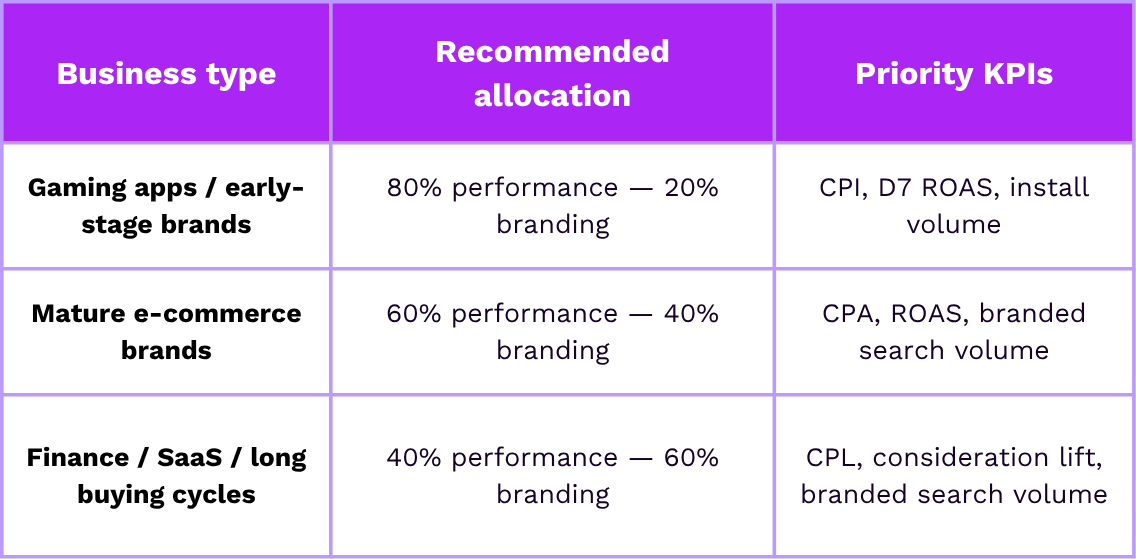
These ratios should be treated as starting points, not fixed rules. The right balance ultimately depends on real-world performance signals.
Performance saturation signals
Before reallocating budget toward branding, marketers first need to identify the right timing. Three concrete signals typically indicate that a performance channel is reaching saturation:
- CPA keeps increasing week after week without any meaningful volume growth,
- Creative frequency rises while CTR declines on top-performing audiences,
- And testing new audience segments no longer delivers incremental performance.
These signals don’t mean performance marketing has stopped working. They indicate that performance now needs to be supported by demand generated higher up the funnel.
How can you measure branding’s impact on performance?
The main obstacle to investing in branding is still its lack of visibility in standard reporting models. A last-click attribution model will never assign a conversion to a brand awareness campaign seen three weeks earlier. That doesn’t mean branding isn’t effective, it means the measurement model itself is incomplete.
Four approaches can help make branding measurable.
- Brand lift studies are incremental measurement methodologies designed to quantify the impact of awareness campaigns on metrics such as consideration, ad recall, and purchase intent through randomized test/control groups. They are natively available on platforms such as Meta, Google, and TikTok, and help capture impact that traditional attribution models fail to measure.
- Tracking branded search volume helps measure the evolution of brand-related searches on Google as an indicator of branding effectiveness. A successful brand campaign generally leads to an increase in branded queries, a signal that can be directly monitored through Google Trends or Search Console.
- Media Mix Modeling (MMM) is a statistical methodology used to quantify the contribution of each media channel, including branding activities, to final conversions by modeling delayed and indirect effects. It remains one of the most robust approaches for making upper-funnel impact visible in reporting.
- Geo lift testing involves running branding campaigns in selected geographic markets while leaving others untouched, then comparing acquisition performance between both groups. It is one of the cleanest ways to isolate the causal impact of branding on performance results.
The 4 questions to ask before balancing your branding vs performance budget
These questions help structure budget allocation decisions without relying on arbitrary ratios.
1. What is my current level of brand awareness? Concrete indicators include branded search volume, direct traffic share, and the proportion of branded keywords within search campaigns. If these metrics remain low or stagnant, branding is not a “nice to have”, it is a prerequisite for sustainable performance efficiency.
2. Where is my performance acquisition starting to saturate? A CPA that keeps increasing over four consecutive weeks without meaningful volume growth, declining CTR on top-performing audiences, or creative frequency exceeding normal thresholds are all signs that performance campaigns are losing efficiency and need to be supported by stronger upper-funnel demand generation.
3. What does my customer decision cycle look like? Long buying cycles rely much more heavily on trust and brand memorability. An app that can be downloaded within seconds does not have the same branding requirements as a SaaS product that involves months of consideration before conversion.
4. Do I have the right tools to measure incrementality? Without the right measurement framework, performance marketing will almost always dominate budget discussions simply because it is easier to track. Implementing at least one incrementality measurement methodology is a prerequisite for making credible allocation decisions.
Conclusion
There is no universal ratio between branding and performance investment. The right balance is a moving variable that needs to evolve continuously based on brand maturity, industry dynamics, buying cycle length, and real-world saturation signals.
In 2026, the brands that outperform are no longer treating branding and performance as competing budget lines. They manage them as part of an integrated system. Performance captures demand. Branding creates it. Over time, relying on one without the other inevitably becomes more expensive.
One final shift also needs to be considered: as AI-powered search and discovery engines become increasingly integrated into user journeys, brand awareness will play a growing role in visibility within generative responses. Brands that nobody knows are unlikely to be surfaced by platforms such as ChatGPT or Perplexity.
FAQ : Budget branding vs performance
What is branding vs performance budget allocation?
u003cp style=u0022text-align: justify;u0022u003eBranding vs performance budget allocation refers to how marketing investments are distributed between brand awareness campaigns and acquisition or conversion-driven campaigns. The right balance should evolve depending on brand maturity, industry dynamics, and buying cycle length.u003c/pu003e
What branding vs performance ratio should brands adopt in 2026?
u003cp style=u0022text-align: justify;u0022u003eThere is no universal ratio. While the classic 60/40 rule remains a common benchmark, the ideal allocation mostly depends on three factors: brand maturity, customer decision cycle, and performance channel saturation signals. A newly launched gaming app may prioritize performance heavily, while an established brand will often benefit from increasing investment in brand-building.u003c/pu003e
Why is performance marketing alone no longer enough?
u003cp style=u0022text-align: justify;u0022u003eOver time, performance channels inevitably reach saturation: CPA increases, CTR declines, and audiences become exhausted. Without demand generation happening higher up the funnel, campaigns end up targeting less responsive audiences, gradually reducing efficiency. The post-ATT environment has only accelerated this phenomenon.u003c/pu003e
How can branding impact be measured?
u003cp style=u0022text-align: justify;u0022u003eSeveral methodologies can be used to measure branding effectiveness, including brand lift studies on Meta, Google, or TikTok, branded search volume tracking, Media Mix Modeling (MMM), and geo lift testing. The goal is to capture the impact that traditional attribution models fail to measure.u003c/pu003e
When should brands rebalance budgets toward branding?
u003cp style=u0022text-align: justify;u0022u003eThree main signals should raise concern: rising CPA without incremental volume growth, increasing creative frequency combined with declining CTR, and audience tests that no longer generate meaningful performance improvements. These signals generally indicate that performance campaigns are starting to hit their limits.u003c/pu003e