In acquisition strategies, search and social both play a central role. They are two key channels for driving traffic, acquiring users, and supporting overall campaign performance. But behind this shared objective, their underlying logic is fundamentally different.
Search is driven by user intent, based on queries actively entered by users. Social, on the other hand, allows campaigns to be delivered directly to targeted audiences within platforms.
These two approaches shape how campaigns are structured, executed, and optimized.
Social vs Search: competing channels or complementary levers within an acquisition strategy? Let the battle begin.
Key Takeaways
- Search and social rely on different mechanics but are part of the same acquisition strategy.
- Search captures existing intent and quickly turns demand into conversions.
- Social drives discovery, builds interest, and fuels the top of the funnel.
- Social creates intent, while search captures and converts that demand.
- The most effective strategies rely on a strong and coherent combination of both channels.
Round 1: User Intent & Funnel Role
Search
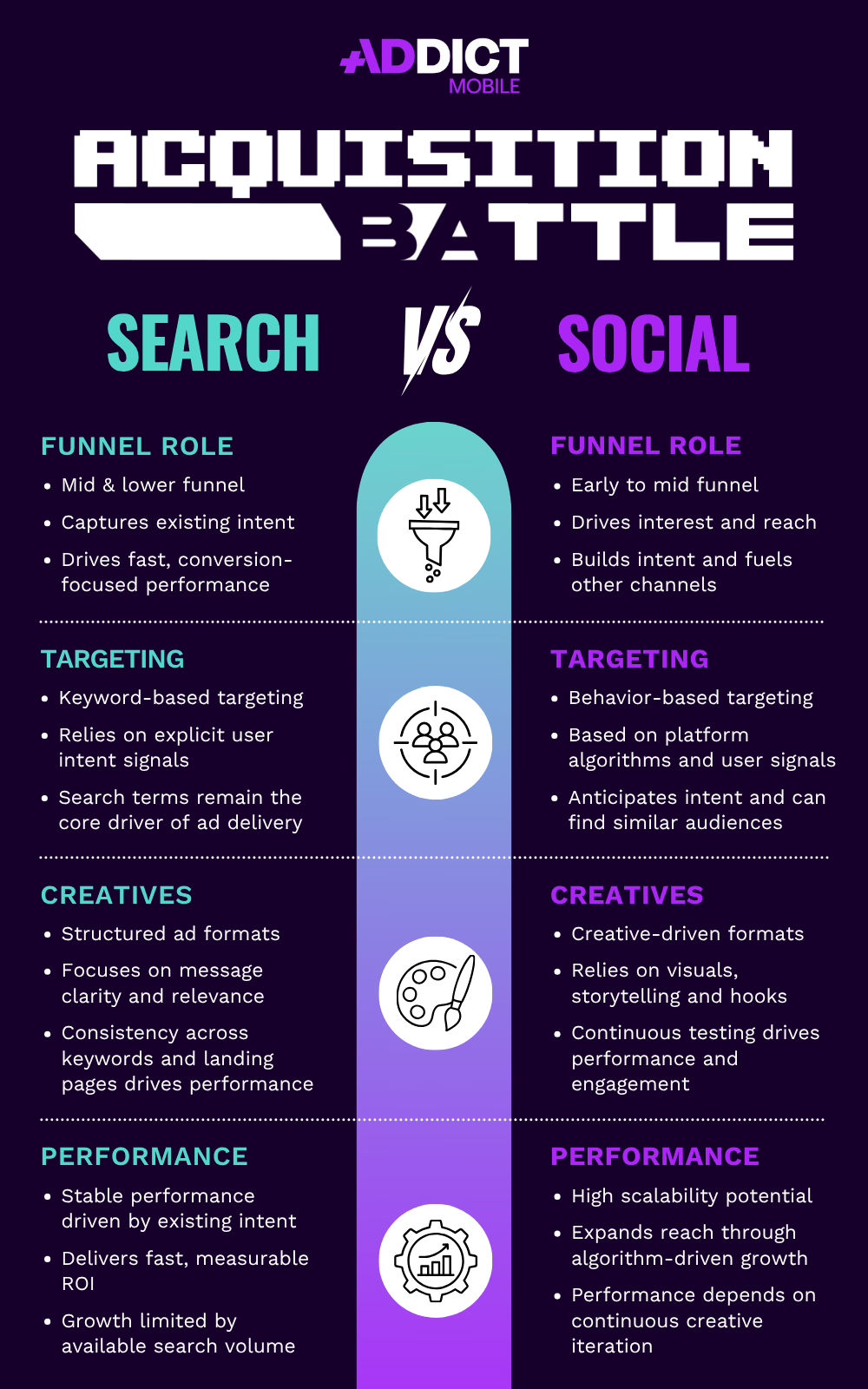
Search follows a straightforward logic: capturing existing intent. When a user enters a query, they are expressing a specific need. Campaigns are designed to appear precisely at that moment, aligning with the user’s request.
This channel primarily operates in the mid to lower funnel, where the user journey is already underway. It tends to drive faster conversions, as users are actively looking for a solution and the campaign responds directly to that need.
Search is therefore highly effective at intercepting existing demand and turning intent into action. However, this strength also defines its limitation: it is less suited for generating discovery or creating demand earlier in the funnel.
Social
Social follows a different logic. Campaigns are introduced earlier in the funnel, before any explicit intent has been expressed.
Platforms rely on behavioral signals and algorithms to identify audiences likely to be receptive to a given offer. The goal is not only to capture existing demand, but also to spark interest and create new use cases.
As a result, social plays a key role in discovery and market expansion. It helps broaden reach, build intent, and in some cases, even fuel other channels such as search.
Round 2: Targeting & Audience Signals
Search
Targeting on search engines primarily relies on keywords and user queries. Each search acts as an explicit signal, directly reflecting what the user is looking for at a specific moment.
Campaigns are typically structured around themes or specific intents, ensuring that ads closely match the most relevant queries.
Targeting can be further refined using additional parameters such as location, device, or audience segments. However, within the search logic, the query remains the core signal that triggers ad delivery.
Social
On social platforms, targeting relies more heavily on behavioral data and platform algorithms. Campaigns are built on signals such as interests, interactions, and past behaviors to identify audiences likely to be receptive to an offer.
Advertisers can also leverage similar audiences, or lookalikes, to extend reach toward profiles that resemble their existing users.
This approach makes it possible to identify potential converters even before they express explicit intent. In return, signal transparency is often lower for advertisers, as it largely depends on platform-driven algorithms.
Round 3: Creatives & Ad Formats
Search
In search campaigns, ad formats remain structured and constrained. Ads must align with the user’s query, delivering a clear and relevant message.
Performance relies on the consistency between the targeted keyword, the ad copy, and the landing page. The goal is to provide a quick, concrete answer to the user’s expressed need.
Creative possibilities are therefore limited, with an approach focused on information and utility. The role of the creative is mainly to clarify the offer or highlight a key benefit. Some formats do include visual elements, particularly in app or shopping campaigns. However, in most cases, the message itself remains the primary performance driver.
Social
On social platforms, by contrast, creative plays a much more central role in campaign performance.
Formats are diverse and immersive, ranging from videos and carousels to UGC-style content. In an environment where users scroll quickly through their feeds, capturing attention becomes a key challenge.
Campaigns often follow a test-and-learn approach, where visuals, hooks, and messaging are continuously tested and optimized to identify the most effective combinations.
In this context, visual hooks, storytelling, and product demonstrations are critical to spark interest, drive engagement, and ultimately trigger conversions.
Round 4: Scalability & Performance
Search
Search delivers stable performance, as campaigns rely on existing demand. Results can come quickly, with ROI often measurable in the short term.
However, this efficiency is tied to a structural limitation: growth depends on available search volume. Once the main queries have been fully leveraged, opportunities for further expansion become more limited.
There are ways to scale, but they remain constrained. These include expanding keyword coverage, entering new markets, or targeting additional categories. As a result, search is less suited for driving large-scale growth.
Social
Social platforms offer a different dynamic, with generally greater scalability.
Algorithms enable campaigns to progressively expand reach to new audiences, based on observed performance. Campaigns can scale in stages, either by increasing budgets or by opening up new audience segments. This allows for rapid volume growth and efficient scaling.
That said, performance is closely tied to the ability to continuously refresh creatives and maintain their effectiveness over time. Without regular iteration, campaigns can quickly lose momentum.
Conclusion
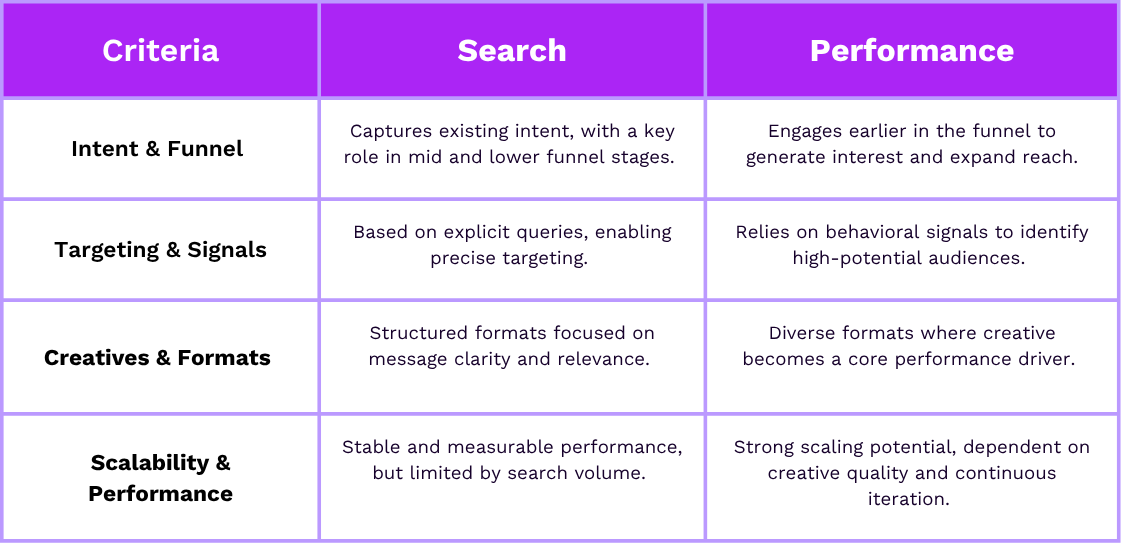
Search and social do not serve the same purpose within an acquisition strategy. Their effectiveness largely depends on how they are combined.
Search captures existing demand with fast, measurable results, but remains constrained by available query volume. Social, on the other hand, expands opportunities in terms of reach and scale, with a stronger reliance on creatives and ongoing iteration.
This is where their complementarity becomes key. When used together, these channels help structure demand while also driving its evolution, allowing acquisition efforts to adapt to different objectives over time. The goal is not to prioritize one over the other, but to build a balanced and coherent strategy.
FAQ Social vs Search
What is the difference between search and social?
Search refers to ads displayed on search engines based on user queries. Social covers ads delivered on social media platforms, targeted according to user profiles and behaviors.
Social vs Search: which one should you choose?
It depends on your objectives. Search is best suited for capturing existing demand, while social helps reach new audiences and generate interest. In most cases, both are used together.
Is search more effective than social?
Not necessarily. Search is often more effective at converting existing demand, whereas social is better for driving volume and increasing visibility. Their effectiveness depends on the context and campaign goals.
Why use social media for advertising?
Social media platforms allow advertisers to reach broad audiences and target users based on their interests and behaviors. They are particularly effective for building awareness and growing an audience.