Over the past few years, mobile acquisition strategies have evolved significantly. Yet one habit still remains: evaluating campaign performance primarily through the first conversion.
For e-commerce acquisition in particular, the first purchase is still often used as one of the main indicators of performance. However, the profitability of an acquisition rarely depends on that first transaction alone.
The real question then becomes: how do you attract users who will not just make one purchase, but several? Looking at acquisition through the lens of long-term user value is therefore key to building truly profitable growth.
Key Takeaways
- The first purchase does not reflect a user’s true long-term value
- Similar CPA can hide major differences in retention and revenue
- Algorithms optimize based on available signals, often short-term focused
- Creatives influence both user profiles and their value potential
- Signals like repeat purchase or 30-day value help steer acquisition toward more profitable users
- Acquisition and retargeting must work together to maximize overall value
1. Why the first purchase should no longer be the only compass
The limits of short-term KPIs
In many e-commerce acquisition strategies, campaign performance is still largely evaluated through immediate metrics such as:
These indicators provide a quick signal of a campaign’s effectiveness and help teams adjust their investments. However, they only offer a partial view of the actual value generated by acquired users.
They fail to capture factors that are essential for e-commerce apps, such as purchase frequency, retention, or the value generated over time. In e-commerce, a significant share of profitability actually comes from repeat purchases.
At a broader market level, this shift toward long-term value is becoming even more critical. In 2025, non-gaming in-app purchases reached $85.6 billion, surpassing gaming revenue for the first time in mobile history. Consumer and e-commerce apps are now the primary revenue engine of mobile.
However, a large part of this potential remains untapped. Mobile cart abandonment stands at 85.65%, meaning most users drop off before completing their purchase. In this context, retargeting high-intent or lapsed users becomes a key lever to recover lost revenue and extend the value generated beyond the first interaction.
The difference between a one-time buyer and a repeat customer
Two campaigns can generate a similar CPA while attracting very different user profiles. Some users make a single purchase, often driven by a promotion or a one-time offer. Others, on the other hand, become regular customers who return to buy again and generate significantly more value over time.
Without a long-term perspective, these profiles remain indistinguishable in e-commerce acquisition analyses, and campaigns continue to be optimized based on signals that do not always reflect the true value of the users being acquired.
2. Acquisition directly influences user quality
The acquisition channel does not only determine the volume of installs generated by a campaign. It also directly shapes the type of users acquired and how they behave once the app is installed.
Not all campaigns attract the same user profiles. Depending on the optimization goals, the signals used, and the creatives running in the campaign, acquired users can show very different levels of engagement, repeat purchases, and long-term value.
Algorithms optimize for more than just volume
Today, a large part of campaign optimization relies on ad platform algorithms. These systems learn to identify the user profiles most likely to complete the action defined as the advertiser’s objective.
If the optimization goal is limited to an install or a first purchase, algorithms will naturally prioritize users who are most likely to complete that action quickly.
These profiles may generate fast conversions without necessarily becoming the most loyal or most profitable customers in the long run.
Creatives influence algorithm learning signals
Creatives also play an important role in this mechanism. They are often associated with CTR or install rate, but their impact goes far beyond these metrics. Visuals directly influence:
- user expectations
- brand perception
- the type of traffic generated
Some creatives tend to attract users who are highly responsive to promotions or one-time offers. Others highlight the brand, product quality, or experience offered within the app.
In increasingly automated environments, creatives therefore become a lever that influences how algorithms learn. By attracting specific user profiles and conversion behaviors, they also help steer optimization toward users who generate more or less long-term value.
More advanced signals to steer campaigns toward value
To guide campaigns toward higher-value users, e-commerce apps need to enrich the signals shared with platforms.
For example:
- second purchase
- average basket value
- purchase frequency
- value generated over 30 days
These signals make it easier to distinguish users who convert quickly from those who generate real long-term value. Algorithms can then learn from profiles that are closer to high-value customers rather than from purely opportunistic buyers.
To be truly effective, however, these signals must remain consistent with the creatives used in campaigns. If optimization relies on value-based signals such as repeat purchases, average basket value, or engagement, the creative strategy must evolve as well.
In practice, this may mean developing creatives that highlight the product experience, long-term usage, or loyalty benefits rather than focusing solely on promotions or immediate purchases.
3. Rethinking how e-commerce acquisition is managed
If the true value of an e-commerce acquisition can no longer be assessed solely through early conversions, teams also need to rethink how they analyze and manage their campaigns.
Adopting a full-funnel approach
In e-commerce, acquisition cannot be reduced to conversion alone. Some campaigns contribute to discovery, others to conversion, and others to re-engagement and repeat purchases.
A full-funnel approach means analyzing campaigns across the entire user journey rather than focusing only on the final conversion point. This perspective makes it easier to understand how different levers work together to generate value.
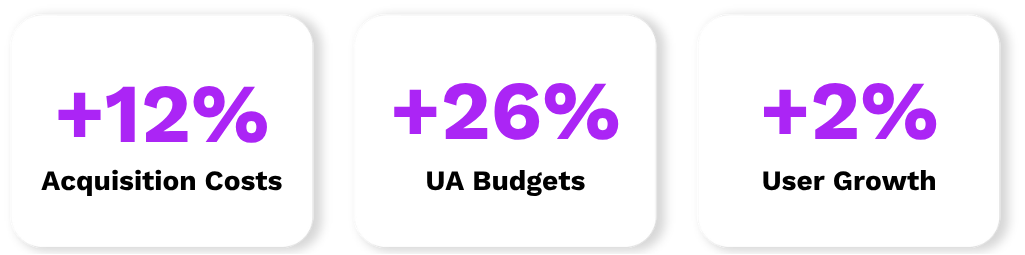
« The numbers tell a pretty clear story right now. UA costs rose 12% year-over-year in 2025, budgets jumped 26%, and user growth stayed nearly flat at 2%. E-commerce brands are spending more to reach fewer genuinely engaged users.
The ones gaining ground have stopped treating acquisition and retargeting as separate workstreams. UA brings a user in. Retargeting is what keeps them from becoming another abandoned cart stat.
When those two work in sync, you get a cleaner read on what is actually driving value across the funnel. Layer in CTV for the brand signal that earns trust at scale, and influencer for the social proof that converts consideration into loyalty, and you have a strategy that compounds.
The brands winning right now are not picking one lever. They are running the full circuit. » — Steve Massaro, Global Head of Agencies, RZR
Managing acquisition with long-term value metrics
Acquisition analysis must include indicators that reflect the value generated over time, such as retention, usage frequency, user value, or the LTV/CAC ratio.
Cohort analysis is one of the approaches that makes this possible. It allows teams to compare how groups of users acquired at different times or through different campaigns evolve, and to identify the sources that generate the most engaged users.
The case of Fidme, a digital wallet app whose value relies on recurring usage, illustrates this approach well. Cohort analysis helped identify the campaigns that were driving the most engaged users.
To optimize campaigns more quickly, an intermediate metric was introduced: Cost per Retained User on Day 1, correlated with Month 4 retention, in order to guide media decisions from the earliest acquisition stages.
The result: +26% MAU and +8 points in Month 4 retention.
Identifying the sources that generate the best customers
Not all acquisition sources generate the same types of users. Some drive volume or conversions quickly but create little long-term value. Others may bring in fewer users but with a much higher potential for repeat purchases or long-term loyalty.
Analyzing performance across multiple purchase cycles helps identify the sources that truly generate the most engaged customers and allows teams to allocate budgets toward the levers that contribute most to long-term value.
Conclusion
In mobile e-commerce, the first purchase remains an important milestone, but it should no longer be seen as the final measure of acquisition performance.
The real question for marketing teams becomes: how can you attract users who will come back and purchase again?
Beyond install volume or immediate conversions, the most effective e-commerce acquisition strategies today are those that succeed in identifying and attracting users who can generate value over time.
FAQ: E-commerce Acquisition
Why is the first purchase no longer enough in e-commerce acquisition?
u003csection class=u0022text-token-text-primary w-full focus:outline-none [u002du002dshadow-height:45px] has-data-writing-block:pointer-events-none has-data-writing-block:-mt-(u002du002dshadow-height) has-data-writing-block:pt-(u002du002dshadow-height) [u0026amp;:has([data-writing-block])u0026gt;*]:pointer-events-auto [content-visibility:auto] supports-[content-visibility:auto]:[contain-intrinsic-size:auto_100lvh] R6Vx5W_threadScrollVars scroll-mb-[calc(var(u002du002dscroll-root-safe-area-inset-bottom,0px)+var(u002du002dthread-response-height))] scroll-mt-[calc(var(u002du002dheader-height)+min(200px,max(70px,20svh)))]u0022 dir=u0022autou0022 data-turn-id=u0022request-WEB:d16134bf-779c-4b19-a893-8b7cc3dd167b-6u0022 data-testid=u0022conversation-turn-14u0022 data-scroll-anchor=u0022falseu0022 data-turn=u0022assistantu0022u003ernu003cdiv class=u0022text-base my-auto mx-auto pb-10 [u002du002dthread-content-margin:var(u002du002dthread-content-margin-xs,calc(var(u002du002dspacing)*4))] @w-sm/main:[u002du002dthread-content-margin:var(u002du002dthread-content-margin-sm,calc(var(u002du002dspacing)*6))] @w-lg/main:[u002du002dthread-content-margin:var(u002du002dthread-content-margin-lg,calc(var(u002du002dspacing)*16))] px-(u002du002dthread-content-margin)u0022u003ernu003cdiv class=u0022[u002du002dthread-content-max-width:40rem] @w-lg/main:[u002du002dthread-content-max-width:48rem] mx-auto max-w-(u002du002dthread-content-max-width) flex-1 group/turn-messages focus-visible:outline-hidden relative flex w-full min-w-0 flex-col agent-turnu0022u003ernu003cdiv class=u0022flex max-w-full flex-col gap-4 growu0022u003ernu003cdiv class=u0022min-h-8 text-message relative flex w-full flex-col items-end gap-2 text-start break-words whitespace-normal outline-none keyboard-focused:focus-ring [.text-message+u0026amp;]:mt-1u0022 dir=u0022autou0022 tabindex=u00220u0022 data-message-author-role=u0022assistantu0022 data-message-id=u0022dfc085bf-563e-41fc-a9d8-ac078da53de7u0022 data-message-model-slug=u0022gpt-5-3u0022 data-turn-start-message=u0022trueu0022u003ernu003cdiv class=u0022flex w-full flex-col gap-1 empty:hiddenu0022u003ernu003cdiv class=u0022markdown prose dark:prose-invert w-full wrap-break-word dark markdown-new-stylingu0022u003ernu003cp data-start=u00220u0022 data-end=u0022231u0022 data-is-last-node=u0022u0022 data-is-only-node=u0022u0022u003eu003cspan class=u0022NormalTextRun SCXW180089343 BCX0u0022u003eBecause it only reflects part of the value generated. In e-commerce, profitability u003c/spanu003eu003cspan class=u0022NormalTextRun SCXW180089343 BCX0u0022u003elargely dependsu003c/spanu003eu003cspan class=u0022NormalTextRun SCXW180089343 BCX0u0022u003e on repeat purchases and the ability to u003c/spanu003eu003cspan class=u0022NormalTextRun SCXW180089343 BCX0u0022u003eretainu003c/spanu003eu003cspan class=u0022NormalTextRun SCXW180089343 BCX0u0022u003e users over time.u003c/spanu003eu003c/pu003ernrnu003c/divu003ernu003c/divu003ernu003c/divu003ernu003c/divu003ernu003c/divu003ernu003c/divu003ernu003c/sectionu003e
Which KPIs should you track for more profitable e-commerce acquisition?
u003csection class=u0022text-token-text-primary w-full focus:outline-none [u002du002dshadow-height:45px] has-data-writing-block:pointer-events-none has-data-writing-block:-mt-(u002du002dshadow-height) has-data-writing-block:pt-(u002du002dshadow-height) [u0026amp;:has([data-writing-block])u0026gt;*]:pointer-events-auto [content-visibility:auto] supports-[content-visibility:auto]:[contain-intrinsic-size:auto_100lvh] R6Vx5W_threadScrollVars scroll-mb-[calc(var(u002du002dscroll-root-safe-area-inset-bottom,0px)+var(u002du002dthread-response-height))] scroll-mt-[calc(var(u002du002dheader-height)+min(200px,max(70px,20svh)))]u0022 dir=u0022autou0022 data-turn-id=u0022request-WEB:d16134bf-779c-4b19-a893-8b7cc3dd167b-8u0022 data-testid=u0022conversation-turn-18u0022 data-scroll-anchor=u0022falseu0022 data-turn=u0022assistantu0022u003ernu003cdiv class=u0022text-base my-auto mx-auto pb-10 [u002du002dthread-content-margin:var(u002du002dthread-content-margin-xs,calc(var(u002du002dspacing)*4))] @w-sm/main:[u002du002dthread-content-margin:var(u002du002dthread-content-margin-sm,calc(var(u002du002dspacing)*6))] @w-lg/main:[u002du002dthread-content-margin:var(u002du002dthread-content-margin-lg,calc(var(u002du002dspacing)*16))] px-(u002du002dthread-content-margin)u0022u003ernu003cdiv class=u0022[u002du002dthread-content-max-width:40rem] @w-lg/main:[u002du002dthread-content-max-width:48rem] mx-auto max-w-(u002du002dthread-content-max-width) flex-1 group/turn-messages focus-visible:outline-hidden relative flex w-full min-w-0 flex-col agent-turnu0022u003ernu003cdiv class=u0022flex max-w-full flex-col gap-4 growu0022u003ernu003cdiv class=u0022min-h-8 text-message relative flex w-full flex-col items-end gap-2 text-start break-words whitespace-normal outline-none keyboard-focused:focus-ring [.text-message+u0026amp;]:mt-1u0022 dir=u0022autou0022 tabindex=u00220u0022 data-message-author-role=u0022assistantu0022 data-message-id=u002217bb95f8-2f2d-4160-8c6a-9466759ea99au0022 data-message-model-slug=u0022gpt-5-3u0022 data-turn-start-message=u0022trueu0022u003ernu003cdiv class=u0022flex w-full flex-col gap-1 empty:hiddenu0022u003ernu003cdiv class=u0022markdown prose dark:prose-invert w-full wrap-break-word dark markdown-new-stylingu0022u003ernu003cp data-start=u00220u0022 data-end=u0022153u0022 data-is-last-node=u0022u0022 data-is-only-node=u0022u0022u003eu003cspan class=u0022NormalTextRun SCXW151101921 BCX0u0022u003eBeyond CPA or short-term ROAS, u003c/spanu003eu003cspan class=u0022NormalTextRun SCXW151101921 BCX0u0022u003eit’su003c/spanu003eu003cspan class=u0022NormalTextRun SCXW151101921 BCX0u0022u003e essential to u003c/spanu003eu003cspan class=u0022NormalTextRun SCXW151101921 BCX0u0022u003emonitoru003c/spanu003eu003cspan class=u0022NormalTextRun SCXW151101921 BCX0u0022u003e retention, purchase frequency, average order value, 30-day value, and the LTV/CAC ratio.u003c/spanu003eu003c/pu003ernrnu003c/divu003ernu003c/divu003ernu003c/divu003ernu003c/divu003ernu003c/divu003ernu003c/divu003ernu003c/sectionu003e
How can you improve user quality in e-commerce acquisition?
u003cspan class=u0022TextRun SCXW235197593 BCX0u0022 lang=u0022EN-USu0022 xml_lang=u0022EN-USu0022 data-contrast=u0022noneu0022u003eu003cspan class=u0022NormalTextRun SCXW235197593 BCX0u0022u003eBy sending more advanced signals to platforms (such as repeat purchase or user value) and aligning creatives with these u003c/spanu003eu003cspan class=u0022NormalTextRun SCXW235197593 BCX0u0022u003eobjectivesu003c/spanu003eu003cspan class=u0022NormalTextRun SCXW235197593 BCX0u0022u003e to attract higher-value users.u003c/spanu003eu003c/spanu003eu003cspan class=u0022EOP SCXW235197593 BCX0u0022 data-ccp-props=u0022{u0026quot;335559739u0026quot;:0}u0022u003e u003c/spanu003e
What role do creatives play in e-commerce acquisition performance?
u003cspan class=u0022NormalTextRun SCXW264152322 BCX0u0022u003eCreatives do more than drive clicks or installs. They shape the type of users u003c/spanu003eu003cspan class=u0022NormalTextRun SCXW264152322 BCX0u0022u003eacquiredu003c/spanu003eu003cspan class=u0022NormalTextRun SCXW264152322 BCX0u0022u003e, their expectations, and their behavior after installation.u003c/spanu003e
Why adopt a full-funnel approach in e-commerce acquisition?
u003cspan class=u0022TextRun SCXW161706078 BCX0u0022 lang=u0022EN-USu0022 xml_lang=u0022EN-USu0022 data-contrast=u0022noneu0022u003eu003cspan class=u0022NormalTextRun SCXW161706078 BCX0u0022u003eBecause value is built across the entire user journey. Combining acquisition, retargeting, and re-engagement helps maximize long-term revenue.u003c/spanu003eu003c/spanu003e