The 2026 World Cup stands out as a unique marketing moment, driven by spikes in attention tied to match moments rather than sustained commercial pressure.
Unlike Black Friday or Christmas, it doesn’t follow a gradual build-up in purchase intent. Attention fluctuates unpredictably, shaped by match schedules and outcomes, often shifting in real time.
With over 5 billion viewers expected over four weeks, it represents a major opportunity. However, performance can vary significantly depending on verticals and geographies, requiring strong real-time responsiveness. This is a four-week marathon. When properly anticipated and executed, campaigns can deliver strong returns.
Key takeaways
- Emotional intent closely tied to match moments (before, during, after)
- Performance varies significantly across geographies and verticals
- Timing should be aligned with matches and tournament phases, not just the calendar
- High volatility driven by results, surprises, and eliminations
- Success depends on the ability to quickly adapt creatives, messaging, and budgets
- Activation strategies differ across verticals (retail, gaming, betting, food, streaming)
1. Understanding the 2026 World Cup dynamics
The World Cup operates around match cycles, not calendar-driven urgency. Each day of competition brings sudden spikes in attention, followed by quieter periods. This is very different from events like Black Friday, where urgency builds gradually in a linear way.
User behavior during the 2026 World Cup is primarily driven by emotion, match context, and local dynamics:
- Emotion: Support for a team or player creates strong engagement
- Competition phase: The group stage offers a high volume of matches, while the knockout rounds bring fewer games but much higher intensity
- Geography: Some countries are deeply football-driven, while others are more neutral
For brands, the challenge is to integrate naturally into these moments without forcing traditional promotional mechanics.
2. Identifying the right activation timing
Campaign timing during the 2026 World Cup is structured around matches and competition phases, not a single key date.
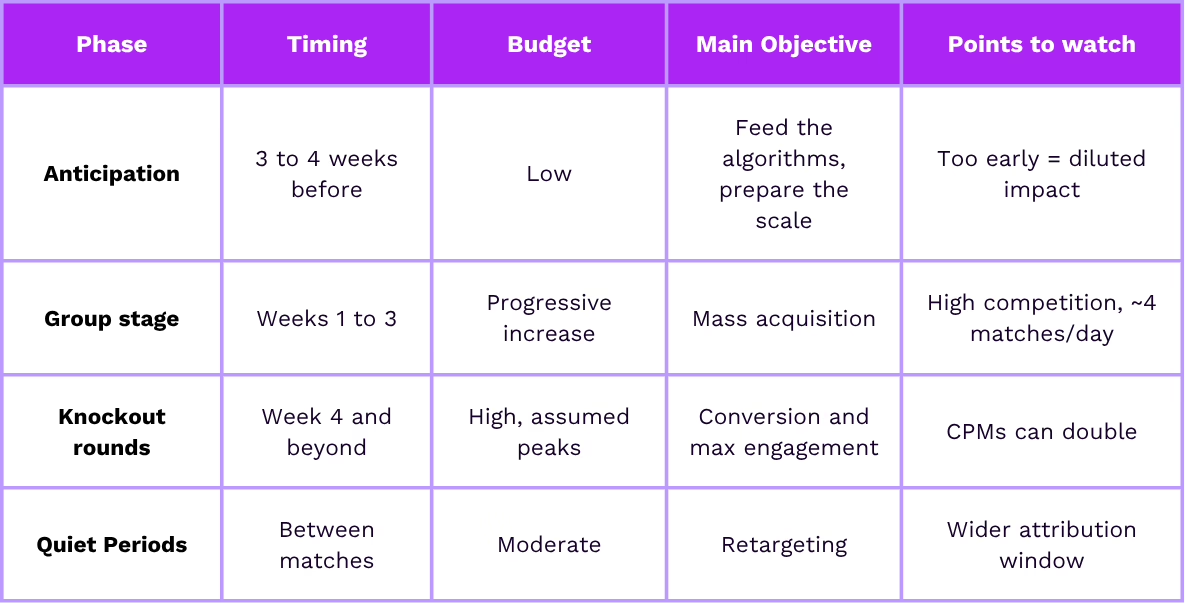
- Anticipation phase (3 to 4 weeks before): Gradual ramp-up with low spend to feed algorithms and prepare for scaling. Launching too early dilutes impact, while starting too late means missing the group stage.
- Group stage (weeks 1 to 3): Around four matches per day. This is the main acquisition phase, with high volume and relatively consistent attention, but also strong competition.
- Knockout stage (week 4 and beyond): Fewer matches, but peak intensity. Audiences become more volatile, driven by excitement, disappointment, or frustration depending on results. The final week concentrates the highest peaks, especially for betting and gaming.
There is no single “key day.” Performance depends on the ability to align with the rhythm of matches rather than a fixed date.
3. Structuring budgets by phase and geography
Advertising pressure evolves significantly throughout the tournament, but not in a uniform way.
CPMs can double between the beginning and the end of the competition. However, this increase is highly concentrated:
- around key moments (major matches)
- and in the most engaged countries
Football-driven markets such as France, Spain, Argentina, Germany, and Brazil experience sharp inflation during their matches. In the United States, increases remain more moderate, except when the national team is playing. Other markets tend to be more opportunistic, with more stable levels of competition.
Recommended approach:
- Gradually increase investment, starting low and scaling during the group stage
- Accept higher costs during the knockout phase
- Adjust this strategy based on geographic differences
It is also essential to keep part of the budget flexible in order to react to unexpected events such as a major team’s elimination, an upset, or a decisive match.
Budget management during the 2026 World Cup ultimately relies on real-time adaptation to attention spikes and geographic variations.
4. Refining audience targeting
Targeting during the 2026 World Cup needs to combine fan base, geography, and timing to maximize performance.
- By fan base: Build highly granular audiences based on teams and countries. Brands can create “Brazil fans” or “Messi supporters” campaigns with tailored messaging for each segment, which resonates far more than generic campaigns.
- By geography of engagement: Adjust investment intensity depending on the market. France, Spain, and Latin America show strong engagement, while other regions are more opportunistic. This goes beyond budget allocation, timing and messaging also need to adapt.
- By behavior: Distinguish between highly engaged fans (strong intent, fast conversions) and more casual audiences (primarily in discovery mode). The former convert quickly, while the latter require more retargeting.
- By moment of engagement: A user landing on match day is more likely to be watching than converting. Someone arriving two days before is much closer to conversion. This varies by vertical though, for example, streaming services can still convert directly during matches. Attribution windows should be adjusted accordingly.
Retargeting also plays a key role. Traffic volumes are high, but immediate conversion fluctuates depending on timing. Structuring tailored retargeting sequences (pre-match, post-match, quieter periods) helps capture the value generated by these attention spikes.
5. Adapting creatives to the context
During the World Cup, creative becomes a central performance driver. Attention spans are short, highly volatile, and deeply emotional. Trends can shift within hours depending on match outcomes.
Performance depends on the ability to quickly adapt content to the context.

Three main approaches stand out:
- Scenario-based creatives: Anticipate different outcomes in advance (win, loss, close game, upset) to react instantly without relying solely on real-time production.
- Real-time creatives: Produce reactive content during the competition (memes, reactions, key moments), which perform particularly well on social platforms.
- Evergreen creatives with adaptation: Maintain a product or branding baseline to sustain performance outside of peak moments.
Creatives that are not contextualized or that remain too generic rarely perform well during this period.
6. Monitoring often overlooked channels
Some environments gain importance during the 2026 World Cup, beyond traditional platforms.
- YouTube: Its new partnership with FIFA significantly strengthens its role around live moments, with match kick-off coverage and a surge in official content (highlights, behind-the-scenes, creator content). Attention is no longer concentrated on TV alone. As a result, audiences cluster around very specific moments (pre-match, kick-off, post-match), increasing pressure on video inventory and driving up costs.
- CTV (Connected TV): Viewing on big screens increases significantly during matches, with longer attention spans. These environments capture highly engaged audiences through premium video formats, while offering more advanced targeting and measurement capabilities than traditional TV. As a complement to other channels, CTV helps extend reach during key moments without relying solely on the most competitive inventory.
7. Adapting strategy by vertical
Marketing strategies during the 2026 World Cup need to be tailored to each vertical, as usage patterns and performance drivers vary significantly.
- Retail: Focus on event-related products, limited editions, or contextualized offers. Peaks consistently occur before major matches, not during. Use Dynamic Product Ads and create urgency around limited stock.
- Gaming: Launch in-game events and dedicated content a few weeks before the tournament to build habits. Scale during the knockout stages when engagement intensifies.
- Betting: Leverage the volatility of odds and real-time developments. However, compliance requirements and responsible gambling messaging are critical.
- Food & beverage: Activate throughout the tournament, not just during key moments. The focus is more on driving engagement around shared experiences than immediate conversion.
- Streaming: Align free trials and promotional offers with key matches, especially the finals. Conversion is driven over time through subscriptions rather than immediate views.
8. Optimizing and pivoting quickly
Make sure your in-app events and web tracking are fully validated well before the matches begin. Tracking issues can significantly impact performance in such a fast-moving and volatile environment.
Adapt your attribution windows :
- Short on match days (2 to 4 hours) to capture immediate intent
- Wider during quieter periods to support retargeting
Monitor key moments in real time, including unexpected results, eliminations, and controversial events. Creatives and messaging may need to be adjusted quickly.
Preparing variations in advance allows for faster and more effective reactions.
Finally, performance should not be measured solely through direct conversions.
In such an emotional context, some moments contribute more to visibility and engagement than to immediate conversion. These signals should be fully integrated into performance analysis.
Conclusion
The 2026 World Cup is a unique marketing moment: volatile, unpredictable, and highly context-driven.
To perform, advertisers need to:
- Anticipate timing by thinking in terms of phases and match cycles
- Adapt budgets based on geography
- Refine audience targeting
- Develop creatives aligned with key moments
- Stay agile in execution
Brands that combine this level of preparation with a deep understanding of their vertical will turn these four weeks into a major opportunity for both engagement and conversion.
FAQ: 2026 World Cup Campaigns
Why is the 2026 World Cup a unique marketing opportunity?
The 2026 World Cup is unique because it is driven by short, intense attention spikes tied to matches, with high volatility depending on results and teams. Unlike other peak periods, performance depends on the ability to adapt in real time.
Should all brands activate around the 2026 World Cup?
No. The 2026 World Cup is most effective for verticals where the product or service naturally aligns with the event (retail, gaming, sports betting, food, streaming). B2B brands or those without a direct connection to the sports context generally see less impact. The challenge is to find a relevant angle rather than forcing a presence.
Should creatives be adapted by team or country during the 2026 World Cup?
Yes. Tailoring messaging and visuals to local audiences or specific fan bases significantly improves performance. Content aligned with a team or a cultural context drives stronger engagement than generic campaigns.
How can brands manage volatility during the 2026 World Cup?
Volatility is inherent to the event. It is essential to anticipate multiple scenarios and prepare creative variations to react quickly. For example, if a favorite team is eliminated, campaigns can pivot toward other teams or alternative messaging angles.
When is the right time to launch 2026 World Cup campaigns?
A phased approach is recommended: start around a month in advance with moderate budgets, scale during the group stage, and intensify during the knockout rounds. There is no single key date, performance depends on aligning with the match schedule.
How should campaign performance be measured during the 2026 World Cup?
Measurement should combine conversion metrics (ROAS, CPI) with engagement and visibility indicators (reach, frequency, interactions). Some moments primarily drive awareness, while others focus on conversion. KPIs should be adapted accordingly across different phases.