UA Digest #14: What’s new this month?

Explore our User Acquisition Digest, your monthly roundup of the latest news and trends in the performance marketing landscape.
Meta updates its conversion attribution model
What’s changing
Meta is evolving its ad attribution system to provide clearer performance insights.
Until now, Meta treated almost any interaction with an ad as a “click” for attribution purposes, including likes, shares, saves, and comments.
Meta now differentiates these actions by separating actual link clicks from other forms of engagement. This update applies to both Facebook and Instagram campaigns and will impact how performance is reported in Ads Manager.
A clearer distinction between clicks and engagement
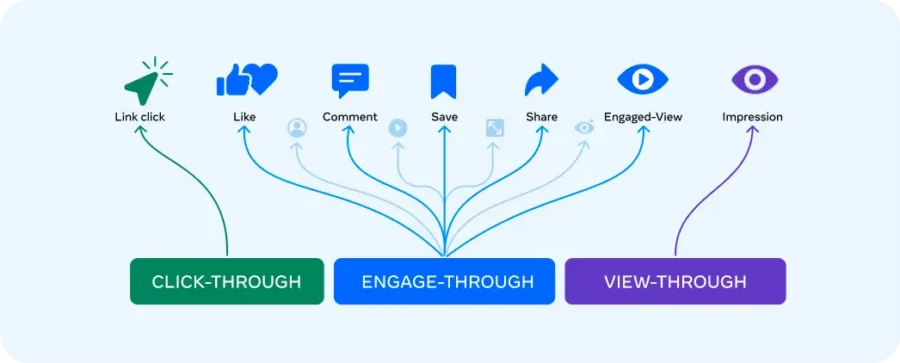
The new model is based on a simple split:
- Click-through attribution, which includes only actual link clicks
- Engage-through attribution, which groups together social interactions such as likes, comments, and shares
Another update: an engaged view is now counted after 5 seconds of watch time, compared to 10 seconds previously. This adjustment reflects the rise of short-form content, where nearly 46% of conversions occur within the first few seconds.
Impact for advertisers
Click-attributed conversions may decrease in reporting, but in most cases, they are simply being reclassified.
This update makes it easier to distinguish between two key dynamics:
- Clicks, which reflect direct intent
- Engagement, which reflects the influence of advertising
It encourages a more granular analysis of the actual role social campaigns play in the conversion journey. Advertisers can now better differentiate between direct intent (click) and social influence (engagement).
Apple Ads expands to Apple Maps
Apple is continuing to expand its advertising ecosystem with the introduction of sponsored placements in Apple Maps.
The platform will allow businesses to promote their visibility directly within search results. The rollout is expected to begin in summer 2026, starting in North America, marking a new step in Apple’s advertising strategy beyond the App Store.
A format built on search and location

The model follows a search-driven logic.
Ads will appear in results when users search for a place or service (restaurant, pharmacy, etc.). Their visibility will depend on:
- relevance
- expressed intent
- keywords used
Apple is bringing the principles of Apple Search Ads into a geo-based context. More info here.
A performance-driven opportunity
This format is built around high intent, with users actively searching, often with an immediate need.
For advertisers, it introduces an additional acquisition lever, particularly for driving foot traffic, with strong relevance for businesses that have a physical presence.
More broadly, Apple continues to expand its ad inventory with formats centered on search and intent.
Meta passes digital taxes on to advertisers
A new cost for Meta campaigns
Meta is introducing a new cost for advertisers with the rollout of “location fees” on certain campaigns.
These fees are designed to offset digital services taxes (DST) imposed by several governments on major tech platforms. Until now, Meta had been absorbing these costs. Starting July 1, 2026, they will be directly passed on to advertisers.
Fees vary depending on targeted countries
These “location fees” are applied based on where ads are delivered, not where the advertiser is located.
Six markets are currently affected, with different rates depending on local regulations:
- 3% in France, Italy, and Spain
- 5% in Austria and Turkey
- 2% in the United Kingdom
In practical terms, the more a campaign is delivered in these markets, the more these fees will add to media costs.
A new factor in acquisition costs
These fees represent a direct increase in campaign costs in the affected markets. While the percentages may seem moderate, their impact can become significant at scale, especially on larger budgets. They come on top of costs that are already under pressure.
Marketing teams will therefore need to factor these fees into their forecasts and performance calculations.
Beyond Meta, this move reflects a broader trend: platforms are increasingly passing regulatory costs on to advertisers.
Google reduces Play Store fees following Epic dispute
A shift in the Play Store business model
Google is updating the Play Store’s economic model by reducing its commission on transactions.
The historic 30% fee is gradually being phased out, with commissions now dropping to 20% or less in certain cases.
This change follows the Epic vs Google lawsuit, which challenged how the Android ecosystem operates and the level of control Google exerts over app distribution.
Toward a more open Android ecosystem
Beyond commissions, Google is introducing several changes to make its ecosystem more flexible:
- The platform is making it easier to install alternative app stores and is launching, outside the United States, the “Registered app stores” program. This initiative allows apps to be distributed and downloaded via third-party stores within a framework approved by Google.
- Developers will also be able to integrate their own payment systems more easily, rather than relying solely on the Play Store’s billing system.
These updates aim to increase competition and provide more flexibility to market players.
More broadly, this decision confirms an ongoing shift: the app store model is increasingly being challenged, pushing platforms to gradually open up their ecosystems.
Apple Ads: more ads in App Store search results
An evolution in ad inventory
Apple is expanding its ad inventory on the App Store by increasing the number of ads displayed in search results.
Until now, a single ad typically appeared at the top of the results. Going forward, multiple ads may be shown directly within the search results page, rather than being limited to the top position. This rollout began in March 2026.
More inventory… but also more competition
This update mechanically increases the available inventory within App Store search.
Existing Search Results campaigns are automatically eligible for these new placements. However, advertisers cannot control exactly where their ads appear: Apple determines positioning based on relevance and bidding.
As a result, multiple sponsored apps can now appear for the same query, including on high-intent keywords.
App Store search becomes even more strategic
More placements create more acquisition opportunities, but also intensify competition.
This evolution reinforces the importance of:
- A strong keyword strategy
- Close alignment between Apple Ads and ASO
- Optimized product pages designed to convert
It also heightens brand protection challenges, with an increased risk of direct competition on branded keywords.
NEWS
Article in relation

Meta Ads vs Google Ads: which platform should…
In 2026, marketing performance no longer relies on a single channel. Effective strategies combine multiple levers that influence every stage of the user...
Published on 17 March 2026
Cheat Sheet #4: Everything You Need to Know…
Mother’s Day holds a unique position in the marketing calendar. Mother’s Day 2026 will once again be an emotional milestone before it becomes...
Published on 9 March 2026
Google Ads 2026: 4 Tips to Adapt to…
Google Ads remains a core pillar of performance marketing for many advertisers. The platform drives volume, captures strong intent, and directly contributes to...
Published on 3 March 2026