Google Ads 2026: 4 Tips to Adapt to Algorithm Changes

Google Ads remains a core pillar of performance marketing for many advertisers. The platform drives volume, captures strong intent, and directly contributes to business results across both web and mobile.
However, Google Ads 2026 no longer works the way it used to. Changes are constant: algorithms, formats, search behaviors, automation. As a result, campaign management has fundamentally evolved.
The challenge is no longer just about optimizing a campaign, but about structuring Google Ads strategies to stay performance-driven in a constantly shifting environment.
Key Takeaways
- Google Ads is moving toward a more automated and unified ecosystem, where traditional levers offer less direct control.
- Performance increasingly depends on strong fundamentals: tracking, data signals, creative assets, and account architecture.
- In a context of more partial data, the goal is no longer to measure everything, but to make decisions based on the right indicators.
- In 2026, mastering Google Ads requires a structured, value-driven approach aligned with real business realities.
1. Google Ads in 2026: What Is (Really) Changing
A More Automated and Unified Ecosystem
Google Ads is not disappearing, but the way it works has changed significantly.
- Search Is Evolving
Queries are getting longer, more complex, and more conversational. User intent is less linear and harder to capture with a strict keyword-by-keyword logic.
- Inventory Is Merging
The lines between Search, Display, YouTube, and Discover are increasingly blurred, shifting toward goal-based campaign structures. Solutions like Performance Max and Demand Gen now act as unified entry points, with the algorithm deciding how and where to serve ads.
- Video Is Now Central
Within YouTube and Demand Gen environments, video plays a key role in discovery strategies, especially for apps. It allows advertisers to deliver richer messages and generate stronger engagement signals that feed optimization.
What This Means in Practice for Advertisers
These changes directly impact how performance needs to be managed.
- Less Control Over Traditional Levers
Granular control over keywords, search terms, or placements is gradually shrinking, as automation takes over more bidding and distribution decisions.
- Increased Pressure on Creatives
With ads distributed more broadly and at a faster pace, creative becomes a core performance lever. Keeping results stable over time increasingly depends on your ability to refresh and iterate creatives to prevent ad fatigue.
- More Fragmented Data
User journeys are less linear, attribution is more complex, and part of performance reporting relies on modeled data when full visibility is no longer available.
The goal is no longer to control everything. It is to build strong fundamentals that allow you to steer performance effectively within a more automated environment.
2. Our Operational Recommendations
In this new Google Ads landscape, performance management is no longer about multiplying settings and tweaks. It is about redefining priorities. The objective is not to automate everything blindly, but to build the right framework so platforms can effectively serve real business goals.
Tip 1: Strengthen Your Tracking to Stay in Control of Performance
Secure Data Collection
- Web: As browser-based tracking becomes less reliable, server-side tracking is no longer optional. Implementing solutions such as the Conversion API, which sends conversions directly from the server, helps secure measurement independently from browser restrictions.
- App: Here, the challenge lies in the solidity of your setup. This means working with a properly configured MMP and ensuring clean, consistent event tracking for your key in-app actions.
Make the Most of Consent Mode
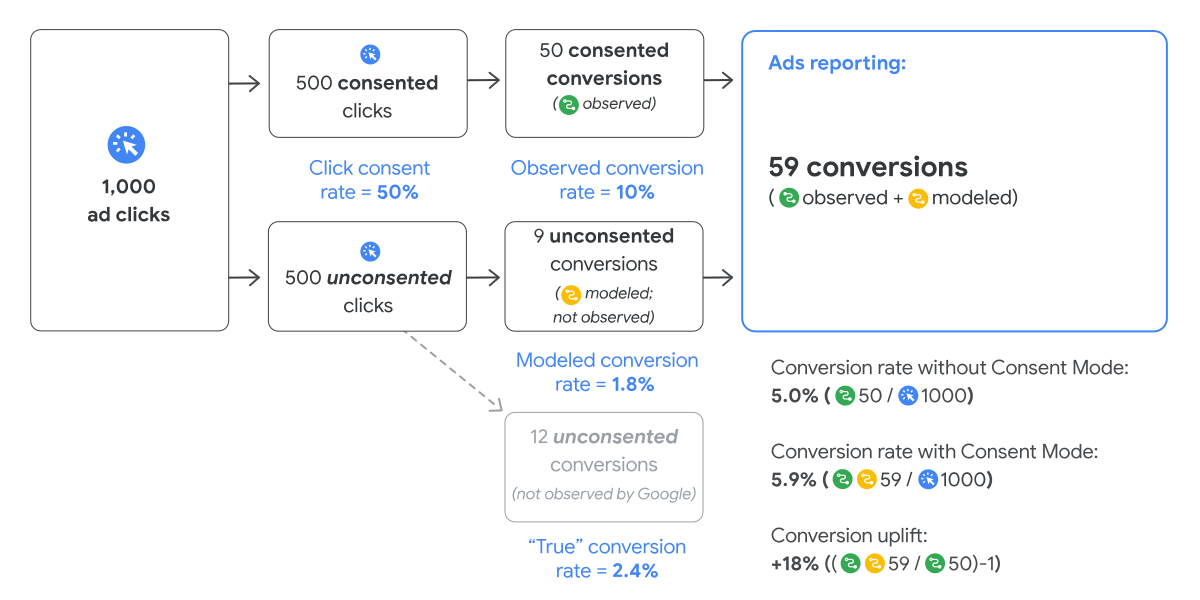
On web environments, a rigorous Consent Mode implementation helps maintain compliance while enabling Google to model missing conversions. Done properly, it limits signal loss and stabilizes optimization.
Reinject Real Business Value
- Web: For long sales cycles or lead generation models, stopping at form submissions is risky. Re-importing offline or CRM conversions allows campaigns to optimize toward actual revenue or qualified outcomes, rather than intermediary actions.
- App : Optimization should integrate qualified post-install events such as purchases, subscriptions, or LTV signals. These are the metrics that reflect real business value.
In an increasingly automated ecosystem, durable and reliable tracking is no longer a competitive advantage.
Tip 2: Optimize for Value, Not Just Volume
ROAS remains a useful day-to-day operational metric. But on its own, it is no longer enough to manage performance effectively.
Bring Google Ads Closer to Business Reality
Beyond revenue or install volume, the real challenge is to integrate actual profitability into campaign management. This means factoring in margin through Profit Bidding, generated revenue, or customer lifetime value (LTV), across both web and app environments, to avoid optimizing toward volumes that are not truly profitable.
Enrich the Signals Sent to Platforms
In practice, this requires sending more granular value signals than a simple conversion event. This can include average basket value, customer or user type, purchase frequency, or usage frequency. The goal is to give bidding strategies the ability to arbitrate more intelligently between volume and profitability.
The richer and more business-aligned the data shared with platforms, the better automation can make relevant investment decisions.
Tip 3: Make Creative a Strategic Performance Lever
As manual targeting becomes less prominent, creative turns into a key lever to influence both performance and distribution.
Build a Diversified Format Strategy
The rise of Demand Gen and the growing importance of visuals in search call for moving beyond a single-format approach. Combining short-form video, images, and text messages allows you to address different stages of the user journey and send richer signals to algorithms.
Adopt an Agile Production Approach
Creative performance no longer depends on one single asset. It relies on the ability to test, refresh, and evolve messaging over time. Varying angles, hooks, and formats helps reduce ad fatigue while identifying what resonates most with different audiences.
Tip 4: Adapt Account Structure and Measurement to Business Objectives
There is no universal Google Ads structure. Account architecture should primarily serve business management needs, not just algorithm learning.
Find the Right Balance Between Consolidation and Segmentation
Consolidation can help the algorithm learn faster, but not at the expense of clarity. The goal is to consolidate when possible and segment when necessary, particularly:
- By product category
- By profitability level
- By app objective such as installs, in-app revenue, or subscriptions
Measure Beyond Last Click or Last Install
With the multiplication of touchpoints, performance can no longer be assessed at the campaign level alone. It needs to be analyzed more globally, by tracking macro indicators such as the Marketing Efficiency Ratio (MER), which compares total revenue to marketing spend, to ensure investments genuinely contribute to growth.
At the same time, it remains essential to maintain an acquisition-focused view, especially by distinguishing new customers from returning users, in order to avoid optimizing only toward remarketing.
Conclusion
In 2026, Google Ads performance is no longer driven by the accumulation of settings, but by the ability to build strong foundations. Tracking, value, creative, and account structure become the real control levers in a more automated and less transparent environment.
The advertisers who outperform are those who adapt their management approach to business realities, rather than simply reacting to algorithm decisions.
FAQ
Yes. Google Ads remains a key performance driver across both web and mobile. However, the way campaigns are managed has evolved, with more automation and fewer manual settings.
The unification of Google Ads inventory, automated bidding, and privacy constraints have reduced granularity across keywords, placements, and attribution. Management now relies more on structuring signals properly than on fine-tuning individual settings.
By thinking beyond a single isolated campaign and taking a more global view, using business-aligned indicators instead of aiming for perfect measurement.
As manual targeting decreases, creative plays a key role in attracting the right audience, qualifying intent, and influencing distribution. Formats, messaging, and refresh pace have a direct impact on performance.
NEWS
Article in relation

Meta Ads vs Google Ads: which platform should…
In 2026, marketing performance no longer relies on a single channel. Effective strategies combine multiple levers that influence every stage of the user...
Published on 17 March 2026
Cheat Sheet #4: Everything You Need to Know…
Mother’s Day holds a unique position in the marketing calendar. Mother’s Day 2026 will once again be an emotional milestone before it becomes...
Published on 9 March 2026
UA Digest #13: What’s new this month?
Discover our User Acquisition Digest, your monthly update on the latest trends and news in performance marketing! Adjust releases its “Mobile App Trends...
Published on 23 February 2026